How Do Pan Depth and Side Shape Affect Cooking?
On this page (11 sections)
Quick answer: Pan depth and side shape control flat cooking area, moisture loss, utensil access, capacity, and containment. Low flared sides favor browning and turning. Tall straight sides hold liquid. Curved sides support whisking and tossing.
Shape does not create heat, but it changes how food, steam, and tools move through the heated vessel.
What Each Shape Does Best
| Shape | Main advantage | Typical tradeoff |
|---|---|---|
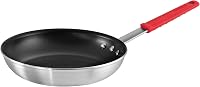
| Low, flared sides | Easy turning and quick evaporation | Less liquid containment |
| Tall, straight sides | Capacity and splatter control | Harder side access |
| Rounded sides | Smooth whisking and tossing path | Smaller defined flat floor |
| Deep body | Headroom and volume | Can retain more steam around food |
How Shape Affects Browning
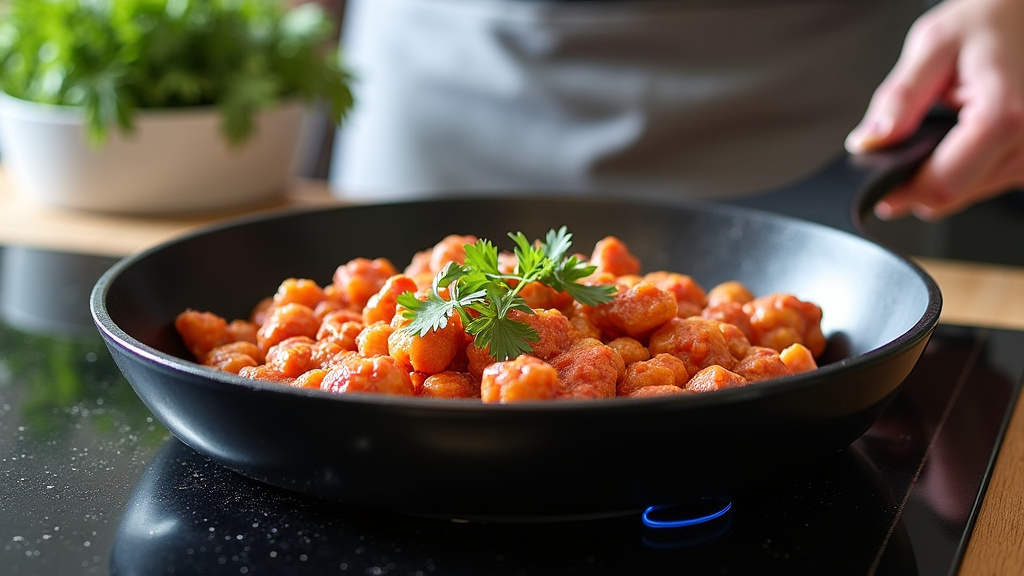
Browning benefits from direct surface contact and moisture escape. A broad cooking surface gives food room to lie in one layer, while a wide opening lets steam leave.
Tall sides do not prevent browning, but crowding a deep pan can hold moist air around the food. For better results, use a sensible batch size and allow space between pieces.
Choose by technique: If the meal begins and ends with dry searing, prioritize floor area and evaporation. If it starts with searing and finishes in sauce, straight sides and a lid become more valuable.
How Shape Affects Liquids and Sauces
Straight walls preserve width as they rise, increasing capacity and reducing the chance that stirred liquid escapes. For a measured volume, see how to measure pot capacity in quarts. A sauté pan uses this geometry to combine a broad floor with useful containment. For practical fill limits, see usable capacity below the rim.
A saucepan is narrower and deeper, which suits smaller liquid jobs. A saucepan and saucier guide explains how rounded corners let a whisk reach easily, reducing places where thick sauce can collect.
Wide openings speed reduction; narrower openings reduce exposed surface. Heat level, lid position, and batch size still matter.
Utensil Access and Handling
Flared walls make it easier to slide a turner under an egg or cutlet. Rounded walls create a smooth path for stirring and tossing. Tall straight walls keep food inside during vigorous mixing but may block a shallow-angled spatula.
Depth also affects visibility and leverage. A deep vessel can make delicate turning awkward, while a shallow one can expose the cook to splatter from wet ingredients.
Safety balance: Pick enough wall height to contain the food without making stirring, turning, or lifting difficult.
Match Common Jobs to a Shape
- Eggs and pancakes: low flared sides for easy turner access
- Cutlets and burgers: broad flat floor for one-layer contact
- Pan sauce after searing: straight-sided sauté pan for liquid control
- Custards and thick sauces: rounded saucier for whisk access
- Soup and pasta: deeper pot for liquid and headroom
- Tossed vegetables: curved sides that guide food back toward the center
How to Compare Pans Before Buying
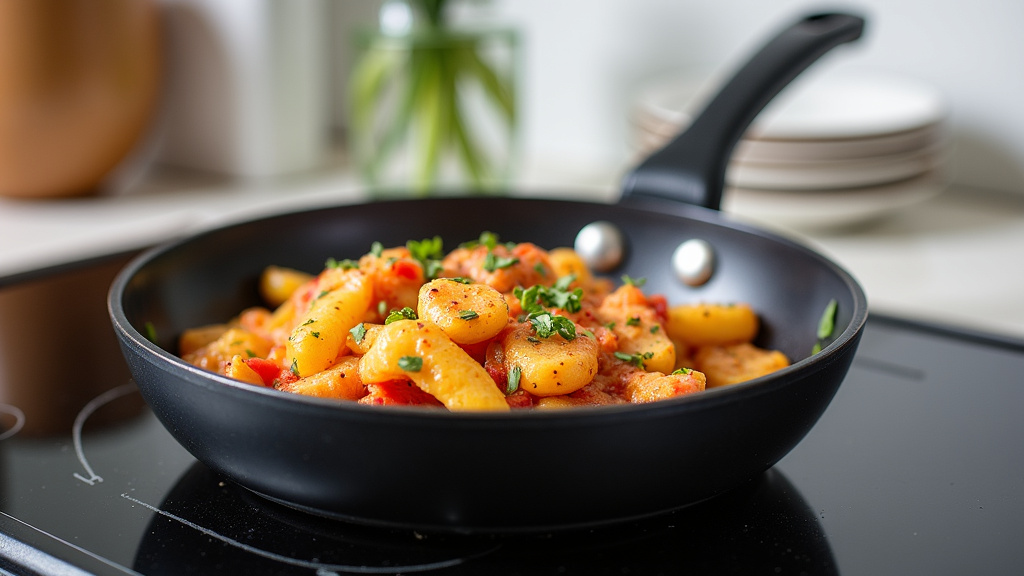
- Measure the flat interior floor, not only the rim.
- Check depth and wall angle.
- Compare exterior base size with the burner.
- Consider loaded weight and handle leverage.
- Confirm lid fit and temperature limits.
- Measure storage, oven, and sink clearance.
Product names are not fully standardized. Two skillets can have different flare, depth, and floor area and capacity; two sauté pans can differ in corner shape and capacity.
Common Mistakes
- Choosing by nominal diameter without checking floor area
- Using a deep crowded vessel when fast browning is the goal
- Using a very low pan for splash-prone liquid
- Assuming greater capacity means greater browning area
- Ignoring how wall shape affects tool access
- Overlooking cooktop, oven, coating, and care limits
One Recipe, Three Possible Shapes
Consider chicken pieces that will be browned and then simmered briefly in sauce.
- A skillet provides easy turning and good evaporation but may contain less sauce.
- A sauté pan provides a broad floor plus straight walls and usually a lid.
- A Dutch oven contains a larger batch and holds heat steadily but offers less side access and more weight.
Each can work. The best choice depends on batch size, desired evaporation, whether the dish goes into the oven, and how much handling the food needs.
This example highlights an important rule: pan names are shortcuts for geometry, not guarantees of one result. Check actual dimensions and instructions. The chef’s pan and wok comparison shows how different shapes guide cooking.
The Bottom Line
Low flared sides favor access and evaporation, straight walls favor containment and capacity, and rounded sides favor continuous stirring or tossing. The best shape is the one that supports the cooking movement and moisture level you use most.
Frequently Asked Questions
Do deeper pans cook more slowly?
Not automatically. cookware materials and performance, heat input, food quantity, and surface exposure all influence timing.
Why does a skillet brown well?
Its broad floor and open, flared sides support contact and moisture escape when the pan is not crowded.
Why are saucier sides curved?
The rounded transition makes whisking easier and reduces tight corners where thick food can collect.
Does a sauté pan hold more than a skillet?
At similar rim sizes, its straight sides often provide more usable capacity, but exact dimensions vary.
Which shape is best for one-pan meals?
A lidded straight-sided pan is often convenient when a meal moves from browning to simmering, but choose based on the recipe and portion.