How Is a Chef’s Pan Different from a Wok?
On this page (12 sections)
- Chef’s Pan vs. Wok at a Glance
- How a Chef’s Pan Cooks
- How a Wok Cooks
- Which Is Better for Stir-Frying?
- Which Is Better for Sauces and Pasta?
- Round-Bottom vs. Flat-Bottom Wok
- How to Choose the Right Pan
- Technique Tips for Better Results
- Common Mistakes to Avoid
- The Bottom Line
- Frequently Asked Questions
- Sources and Further Reading
Quick answer: A chef’s pan is a wide, moderately deep pan with curved or sloped sides and a larger flat base. A wok has a small hot zone at the bottom and high sweeping walls built for movement, heat zones, and rapid batch cooking.
Choose a chef’s pan for sauces, pasta, risotto, shallow frying, and familiar one-pan meals. Choose a wok for stir-frying, tossing, steaming, and techniques that use its curved shape deliberately.
The two pans can look similar from above, particularly when the wok has a flat bottom. Their proportions are different, and those proportions influence where heat concentrates and how food moves.
Neither name guarantees a specific material or size. Compare the flat base, wall curve, handle layout, weight, and cooktop fit of the exact models.
Chef’s Pan vs. Wok at a Glance
| Feature | Chef’s pan | Wok |
|---|---|---|
| Flat floor | Relatively broad | Small on a flat-bottom model; absent on a round-bottom model |
| Walls | Moderately curved or sloped | High and continuously sweeping |
| Heat use | Even cooking across the base | Hot center plus cooler upper zones |
| Best work | Sauces, pasta, grains, shallow frying | Stir-frying, tossing, steaming, deep-frying |
How a Chef’s Pan Cooks
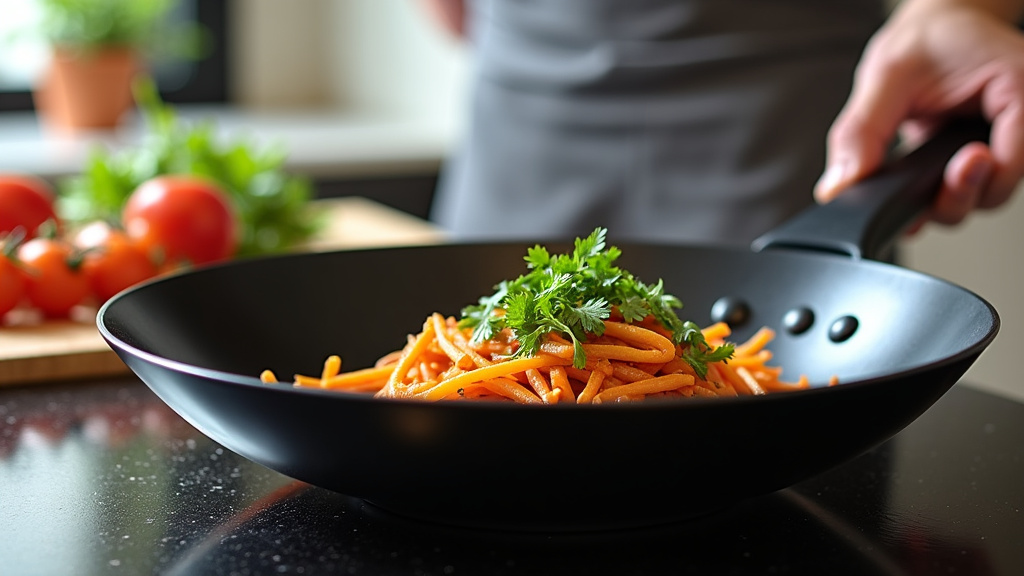
A chef’s pan usually offers a generous flat base, so several ingredients can cook in direct contact with the surface. Curved sides make stirring easier than in a sauteuse and saute pan differences.
That combination suits recipes that begin with sauteing and continue with liquid: pasta sauce, curry, risotto, grains, and one-pan meals.
Common strengths:
- Broad stirring and whisking access
- Enough flat area for moderate searing
- Depth for sauce and simmering
- A familiar fit on common flat cooktops
How a Wok Cooks
A wok concentrates heat at its bottom while its high walls create room to move food away from that intense zone. Ingredients can be cooked in stages and held briefly along the sides.
The walls also contain tossed food and splatter. With compatible accessories, a wok can steam, simmer, deep-fry, and smoke foods in addition to stir-frying.
A wok does not create restaurant-style results by shape alone. Burner output, batch size, preparation, material, seasoning or coating, and technique all matter.
Fast decision: Choose a chef’s pan when food should sit across a broad base. Choose a wok when food should move rapidly between the hot bottom and sloped walls.
Which Is Better for Stir-Frying?
A wok is the purpose-built choice. Its high sides give ingredients room to move, and its relatively small bottom encourages cooking in manageable batches.
A chef’s pan can make a good vegetable or noodle stir-fry on a standard range, especially if it has responsive construction. Keep portions modest and let moisture escape rather than piling ingredients deeply.
Which Is Better for Sauces and Pasta?
A chef’s pan is generally easier. Its broad base supports sauteing, while its curved sides help pasta and sauce combine under a spoon or tongs. For another useful shape comparison, see the skillet and sauté pan guide.
A wok can simmer sauce, but its deep curve creates a smaller contact zone. It is better when the recipe uses the wok’s movement and heat distribution rather than treating it as a conventional pan.
Round-Bottom vs. Flat-Bottom Wok
A traditional round-bottom wok requires a compatible support and heat source. It may be unstable or ineffective on a flat electric, glass, or induction surface.
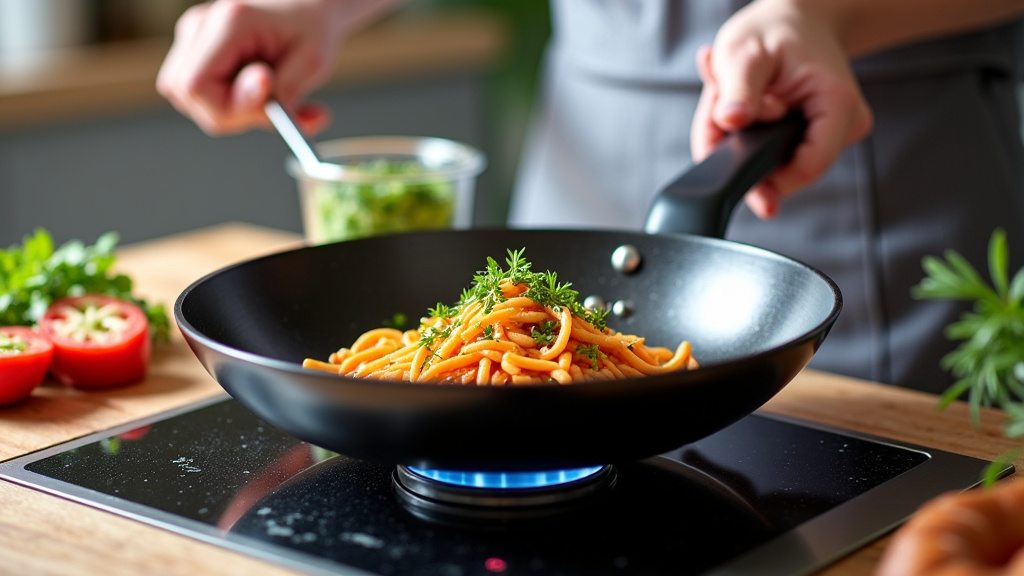
A flat-bottom wok sits securely on common ranges while keeping high, curved upper walls. It is still a wok, but the flat section changes how heat enters the pan.
For induction, verify that the exact flat base is magnetic and appropriately sized. Do not use an unstable wok ring or adapter unless the cooktop and cookware manufacturers permit it.
How to Choose the Right Pan
- Start with your recipes. Saucy one-pan meals favor a chef’s pan; frequent stir-fries favor a wok.
- Match the cooktop. Confirm base shape, induction compatibility, and stability.
- Check the weight. A wok should be manageable for your technique; a chef’s pan should be safe when full.
- Review handles. Woks may use one long handle or two loops; chef’s pans vary.
- Confirm lid and oven limits. Every component can have a different rating.
- Follow material-specific care. Carbon steel, stainless steel, cast iron, and nonstick surfaces need different handling.
Technique Tips for Better Results
Prepare before heating
Stir-frying moves quickly. Cut ingredients, mix sauce, and place tools nearby before the wok becomes hot.
Use smaller batches
Overloading either pan drops the surface temperature and traps steam. Cook in stages when browning matters.
Respect the surface
Use utensils, oils, and heat levels approved for the exact material or coating. A carbon-steel wok and nonstick chef’s pan cannot be treated identically.
Safety check: Toss only a load you can control. Keep the pan stable, turn long handles away from traffic, and remember that wok walls and loop handles can become extremely hot.
Common Mistakes to Avoid
- Buying a round-bottom wok for an incompatible flat cooktop
- Crowding the wok and steaming food instead of stir-frying
- Expecting a chef’s pan to develop distinct heat zones like a wok
- Using high heat on a coating that does not permit it
- Ignoring the size of the flat base when comparing models
Best fit for a typical home range
A chef’s pan is the easier generalist. A flat-bottom wok is the better specialist when you want to learn and use wok techniques regularly.
The Bottom Line
A chef’s pan spreads food across a broader floor and favors sauces, grains, and familiar one-pan cooking. A wok concentrates heat and creates space for movement. Choose based on technique and cooktop—not appearance alone.
Frequently Asked Questions
Can a chef’s pan replace a wok?
It can make stir-fried dishes, but it does not reproduce a wok’s deep curve, concentrated hot zone, or high walls.
Can a wok replace a chef’s pan?
It can simmer and saute, but its smaller floor may be less convenient for broad, even contact.
Is a flat-bottom wok still a real wok?
Yes. It adapts the base for common cooktops while retaining high curved walls.
Which is easier for beginners?
A chef’s pan behaves more like familiar Western cookware. A wok rewards deliberate heat control, preparation, and batch cooking.
Which one is better for induction?
Either can work when the exact flat base is induction-compatible and properly sized for the cooking zone.


