How Does a Sauteuse Differ from a Saute Pan?
On this page (12 sections)
- Sauteuse vs. Saute Pan at a Glance
- Why the Sauteuse Has Curved Sides
- Why the Saute Pan Has Straight Sides
- Best Uses for a Sauteuse
- Best Uses for a Saute Pan
- Which One Is Better for Searing?
- Which One Is Better for the Oven?
- How to Choose Between Them
- Common Mistakes to Avoid
- The Bottom Line
- Frequently Asked Questions
- Sources and Further Reading
Quick answer: A sauteuse is typically a wide, round, two-handled pan with gently curved sides. A saute pan usually has straight sides, a long handle, and a helper handle.
Choose a sauteuse for stirring, risotto, oven finishing, and table serving. Choose a saute pan for broad searing, stovetop maneuvering, shallow frying, and pan sauces.
Cookware names are not perfectly standardized. Some brands use “sauteuse” for a shallow casserole, while others use it for a curved pan close to a saucier.
Instead of relying on the name, compare wall shape, handle layout, pan cooking surface size, depth, and lid.
Sauteuse vs. Saute Pan at a Glance
| Feature | Sauteuse | Saute pan |
|---|---|---|
| Handles | Usually two short side handles | Usually one long plus one helper handle |
| Interior | Often curved at the floor and walls | Broad flat floor with straighter sides |
| Movement | Balanced two-hand lift | Easy stovetop positioning with long handle |
| Best use | Stirring, reducing, oven finishing | Searing, shallow frying, pan sauces |
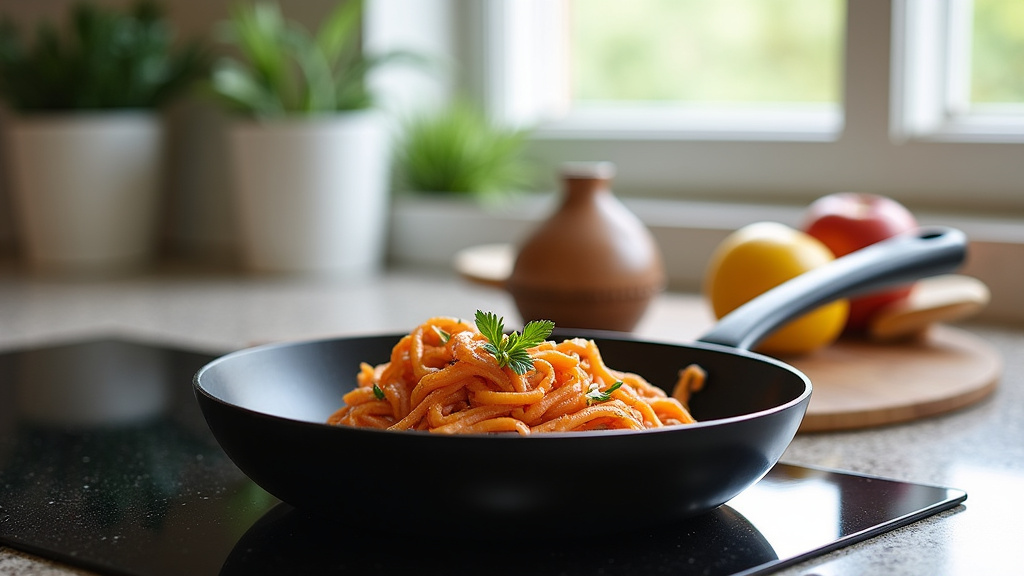
Why the Sauteuse Has Curved Sides
A rounded transition between floor and wall helps a spoon or whisk follow the interior. That is useful for risotto, polenta, sauces, grains, and mixtures that need frequent stirring.
The wider opening also encourages evaporation. You can reduce a sauce while seeing and reaching most of the cooking surface.
Short handles make the vessel compact in an oven and on a table, but they also become hot and require two-handed lifting.
Why the Saute Pan Has Straight Sides
skillet and saute pan differences. Food can be arranged in one layer for searing, and the vertical walls contain liquid or oil.
The long handle helps you reposition the pan, while the helper handle supports its weight when full. This layout is practical for stovetop work but takes more oven and cabinet space.
Do not buy by name alone: A brand may label a straight-sided shallow casserole “sauteuse.” Inspect the photos and dimensions to confirm the shape you want.
Best Uses for a Sauteuse
- Risotto: curved corners improve spoon access.
- Polenta and grains: the open interior is easy to stir.
- Reductions: a broad opening releases moisture.
- Oven-finished rice or casseroles: short handles conserve oven space.
- Serving: balanced side handles and a compact profile suit the table.
Best Uses for a Saute Pan
- Searing: the flat floor maximizes direct contact.
- Pan sauces: straight walls contain added liquid.
- Shallow frying: wall height helps control oil and splatter.
- Braising: many models include a lid for the covered stage.
- Stovetop meals: the long handle makes burner positioning easier.
Which One Is Better for Searing?
A saute pan normally has the advantage because its wide flat floor gives food more direct contact. However, a sauteuse with a sufficiently wide, heavy base can also sear effectively.
For either vessel, dry the food, preheat appropriately, and avoid crowding. Construction and technique affect browning more than the product name.
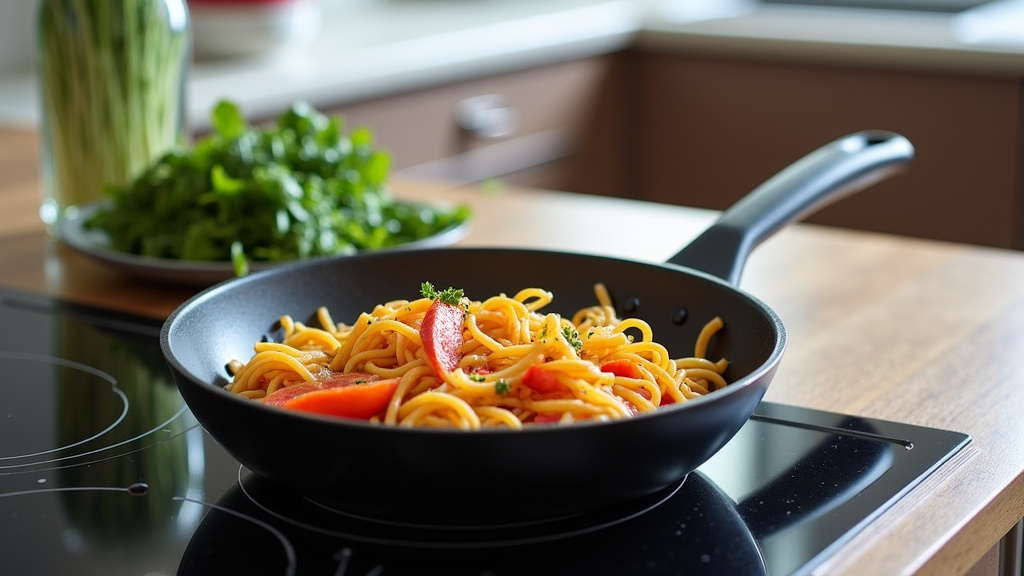
Which One Is Better for the Oven?
A sauteuse is often easier to fit because it lacks a long handle. Two short handles also provide a balanced lift from oven to counter.
A saute pan may still be fully oven-safe. Check the exact model’s body, coating, lid, knob, and handle limits. Never assume a metal-looking component is approved for unlimited heat or broiler use.
How to Choose Between Them
- Review your main recipes. Frequent stirring favors a sauteuse; wide searing favors a saute pan.
- Measure the flat floor. Rim diameter does not show usable searing area.
- Consider handle style. Long handles suit stovetop movement; short handles suit oven and storage.
- Check filled weight. Both can become heavy with food and liquid.
- Confirm the lid. A fitted lid expands either pan’s covered-cooking ability.
- Verify compatibility. Review induction, oven, broiler, utensil, and cleaning guidance.
Safety check: A sauteuse’s short handles sit close to the hot body and may heat quickly. Use dry protection on both handles and lift away from steam when removing the lid.
Common Mistakes to Avoid
- Assuming every product called a sauteuse has curved walls
- Comparing only top diameter instead of flat cooking area
- Using a small burner under a very wide base
- Forgetting that two short handles get hot during stovetop cooking
- Buying both shapes when one already covers your usual recipes
Best practical choice
Pick the sauteuse for spoon and whisk access. Pick the saute pan for a larger flat searing floor and long-handle control. If the actual shapes are nearly identical, choose by construction, size, and handling.
The Bottom Line
A sauteuse is generally a compact, two-handled vessel designed for stirring and oven-to-table use. A rondeau pan guide explains another two-handled vessel used for browning and braising. A saute pan is a straight-sided stovetop workhorse designed for searing and containing liquid. Product labels vary, so verify geometry before buying.
Frequently Asked Questions
Is a sauteuse the same as a saucier?
Sometimes the shapes are similar, but labels vary. A saucier commonly has one long handle, while a sauteuse often has two short handles.
Can a sauteuse go in the oven?
Only when the manufacturer approves the exact body, handles, lid, and finish for the intended temperature.
Which is easier to pour from?
A saute pan offers one-hand tilting with its long handle. A sauteuse offers a balanced two-hand lift. Rim design and filled weight also matter.
Can a saute pan make risotto?
Yes. Its wide floor works, though a curved sauteuse may be easier to stir around the edges.
Do I need both?
No. Their capabilities overlap heavily. Own both only if the different handles and interior shapes solve recurring needs.


