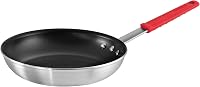
Why Is a Pan’s Cooking Surface Smaller Than Its Listed Diameter?
On this page (11 sections)
- Listed Diameter vs. Cooking Surface
- How Wall Shape Uses the Diameter
- Why Manufacturers Use Flared Sides
- How to Measure Usable Cooking Space
- How Smaller Floor Area Changes Cooking
- Which Shape Should You Choose?
- Common Shopping Mistakes
- Three Real-World Examples
- The Bottom Line
- Frequently Asked Questions
- Sources and Further Reading
Quick answer: A pan is normally sized at its wide top opening, but its sides curve or flare inward toward the base. As a result, the flat floor that touches food is smaller than the listed diameter.
Wall angle and corner radius determine how large the difference is, so two pans with the same label may provide different browning space.
This is not necessarily a design flaw. Flared sides improve utensil access and evaporation. The important point is to compare the measurement that matches your cooking goal.
Listed Diameter vs. Cooking Surface
| Dimension | What it describes | Best use |
|---|---|---|
| Listed diameter | Usually the top interior opening | Identifying nominal size |
| Flat cooking surface | Level interior floor | Estimating one-layer food capacity |
| Exterior base | Bottom contact area | Matching burner or induction zone |
| Overall width | Rim plus handle or grips | Storage and oven clearance |
How Wall Shape Uses the Diameter
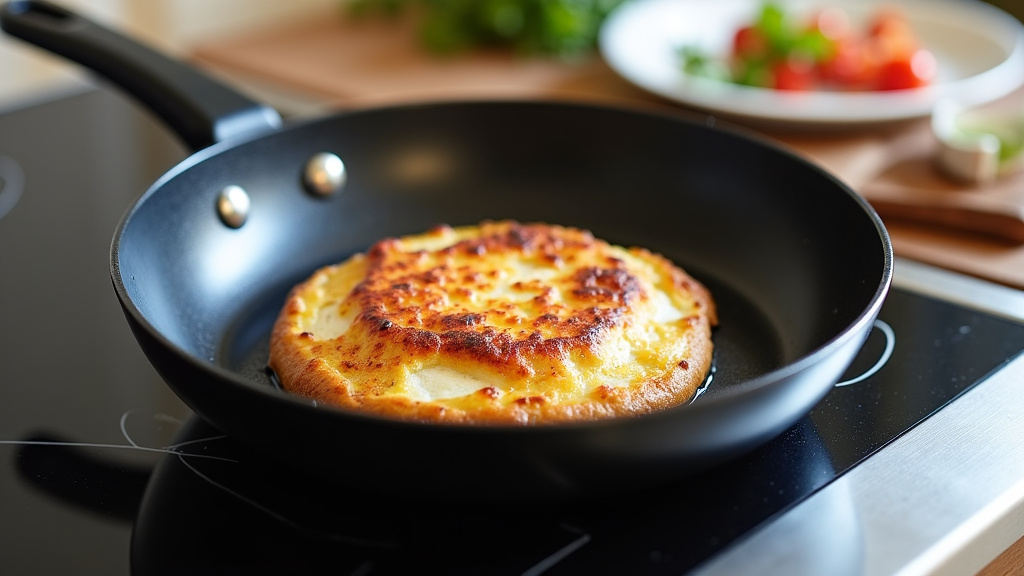
A frying pan’s wall begins where the flat floor curves upward. If that wall flares outward strongly, it consumes more of the difference between the base and the rim.
A straight-sided sauté pan preserves more width near the bottom. It may therefore offer more flat area and liquid capacity than a skillet with the same top diameter.
Curved corners add their own effect. A broad radius creates a smooth path for whisking or tossing but reduces the sharply defined flat floor.
Practical rule: For searing several portions, compare flat-floor dimensions. For flipping and tossing, consider whether the flare and curved corners make access easier.
Why Manufacturers Use Flared Sides
Flared sides make it easier to slide a turner under eggs, pancakes, fish, and cutlets. They also expose more food and liquid to open air, which can speed evaporation. See how pan depth and side shape affect other cooking tasks.
Those qualities are useful for browning and reducing moisture. The tradeoff is less contained capacity and a smaller flat floor than the rim measurement suggests.
How to Measure Usable Cooking Space
- Let the empty pan cool and place it on a level surface.
- Measure the top opening through its center.
- Measure the flat interior floor before the wall begins to curve.
- Record the depth and wall profile.
- Compare the exterior base with your burner or induction zone.
When shopping online, look for a dimension drawing or a listed cooking-surface diameter, and use this guide to measure a frying pan. If neither is available, the nominal diameter alone cannot tell you exactly how many items will fit.
How Smaller Floor Area Changes Cooking
Food browns best when pieces have direct surface contact and enough surrounding space for moisture to escape. Crowding a small floor can trap steam and slow browning.
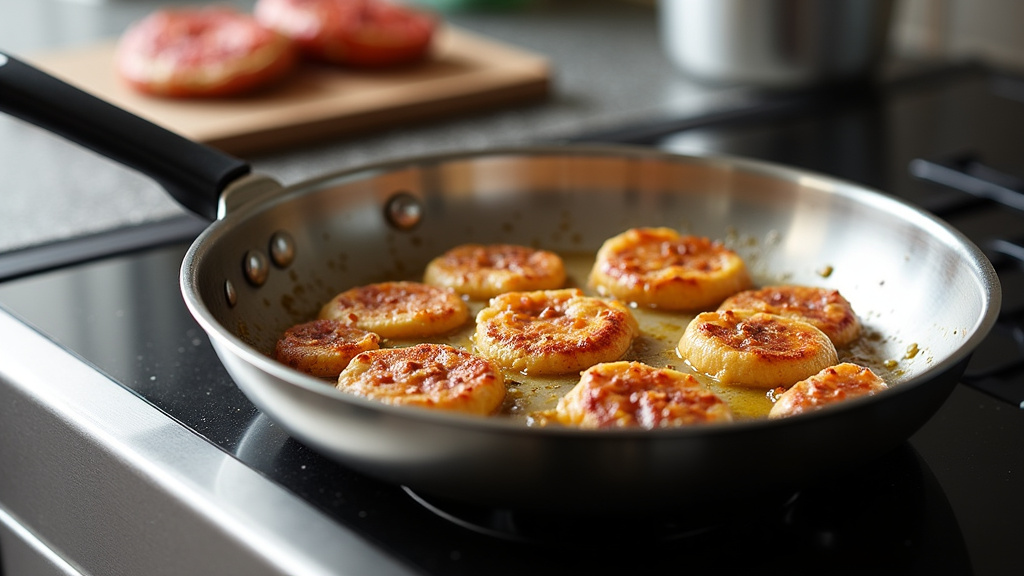
A pan may technically hold four portions, yet only three may fit flat without overlap. The right size therefore depends on the food footprint, not only the pan label.
Do not oversize blindly: A pan much wider than the burner may heat unevenly. Match the exterior base to the appliance guidance as well as the interior floor to the food.
Which Shape Should You Choose?
Choose stronger flare when:
- You frequently turn delicate food
- You toss ingredients by moving the pan
- You want faster evaporation
- You prefer easy side access
Choose straighter sides when:
- You need more flat floor or liquid capacity
- You finish seared food with sauce
- You want better splatter containment
- You often use a lid
Common Shopping Mistakes
- Assuming listed diameter equals browning diameter
- Comparing only top openings
- Ignoring base size and burner coverage
- Choosing a larger pan that is too heavy when loaded
- Forgetting cabinet, sink, or oven clearance
- Overlooking manufacturer heat and care limits
Three Real-World Examples
Cooking four burger patties
The rim may look wide enough, but the patties need to sit on the flat floor without overlapping or climbing the wall. Floor diameter is the better number.
Making an omelet
A curved transition can help the cooked egg release and fold even though it reduces the perfectly flat center. Here, geometry supports movement rather than maximum capacity.
Reducing a pan sauce
The exposed surface at the top influences evaporation, while the floor supports initial browning. A pan can be efficient for both even when the two diameters differ. For an example of how pan shape changes these tradeoffs, see the chef’s pan and wok guide.
This is why the “missing” width is not truly lost. It becomes working space for tools, food movement, and moisture escape.
The Bottom Line
The cooking surface is smaller because the listed diameter usually describes the wide rim while the walls narrow toward the base. Measure the flat floor for real browning area, and judge the flare as a useful design choice rather than wasted space.
Frequently Asked Questions
How much smaller is the cooking surface?
There is no fixed difference. Wall angle, depth, and corner radius vary by model.
Does a sauté pan have more cooking area than a skillet?
At the same rim diameter, a straight-sided sauté pan often preserves more floor area, but exact dimensions should be checked.
Is the exterior base the same as the interior floor?
Not necessarily. Construction layers and wall shape can make them different.
Why not size pans by flat floor?
Nominal sizing conventions emphasize the opening, but detailed product specifications may also list base or cooking-surface dimensions.
Does more flat area always mean a better pan?
No. It supports batch browning, while flared sides improve access and evaporation. The better geometry depends on the task.