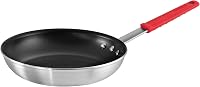
How Do You Measure a Frying Pan’s Diameter?
On this page (11 sections)
- The Four Measurements That Matter
- How to Measure Step by Step
- Why the Flat Floor Is Smaller
- Measuring for a Replacement Lid
- Measuring for Burner Compatibility
- Common Measurement Mistakes
- How to Compare Two Frying Pans
- Three Reasons to Keep the Measurements
- The Bottom Line
- Frequently Asked Questions
- Sources and Further Reading
Quick answer: Measure a frying pan straight across the inside of the top rim, through the center. That is usually the nominal diameter. Also measure the flat interior floor because it tells you how much food can brown in one layer.
For burner fit and storage, record the exterior base and total width separately.
A pan described as 10 inches may have a noticeably smaller flat cooking surface because the sides flare outward. Measuring more than one dimension prevents disappointing replacements and mismatched lids.
The Four Measurements That Matter
| Measurement | How to take it | Why it matters |
|---|---|---|
| Top diameter | Inside rim to inside rim through center | Nominal pan size |
| Flat cooking floor | Across the level interior before the side curve | One-layer browning space |
| Exterior base | Across the bottom contact area | Burner or induction-zone fit |
| Overall width | Include handles or helper grips | Cabinet, oven, and sink clearance |
How to Measure Step by Step
- Place the empty, cool pan on a stable, level surface.
- Stretch a rigid ruler or tape across the top opening.
- Find the widest line that passes through the center.
- Measure from inner edge to inner edge unless the manufacturer defines size differently.
- Repeat across the flat interior floor and exterior base.
- Write down depth, total handle length, and any lid-seat measurement you need.
If the pan is out of round, take two measurements at right angles. A meaningful difference may indicate warping or damage.
Most useful shopping note: Record both “top opening” and “flat floor.” The first helps identify the labeled size; the second predicts how many cutlets, eggs, or burger patties will fit without crowding.
Why the Flat Floor Is Smaller
Most frying pans have pan depth and side shape. The opening widens above the base, so the top diameter is larger than the level cooking area.
That shape is useful: flared sides give a turner better access and help moisture escape. The tradeoff is less direct contact area than the headline diameter might suggest.
Measuring for a Replacement Lid
The advertised pan diameter is not always enough to match a lid. Measure the place where the lid actually rests, including the inner ledge or rim seat. Note whether the rim is flat, rolled, or flared.
A suitable lid should sit level without falling inward, rocking excessively, or striking the side handles. Manufacturer compatibility information is more reliable than a “universal” label.
Do not force a fit: A lid that binds, balances precariously, or leaves unstable gaps can create a spill or steam hazard.
Measuring for Burner Compatibility
Compare the exterior flat base—not the flared rim—with the burner or induction zone. A pan that extends far beyond the heat source may develop a large temperature difference between the center and edge.
For induction, confirm that the exact pan is compatible and follow the cooktop manufacturer’s zone-size requirements. Magnetic attraction alone does not describe every performance or safety requirement.
Common Measurement Mistakes
- Measuring the outside rim when the product uses an inside dimension
- Stopping short of the center and recording a chord instead of the diameter
- Using the nominal diameter as the flat cooking area
- Forgetting the handle when checking cabinet or oven clearance
- Matching a lid only by the pan’s advertised size
- Ignoring distortion in an older or damaged pan
How to Compare Two Frying Pans
Use the same method on both. Compare top opening, flat floor, depth, base, wall angle, and overall width. Then consider loaded weight, handle comfort, construction, coating, and care requirements.
A larger rim does not automatically mean more useful browning space. A slightly smaller straight-sided pan can offer more floor area than a strongly flared one.
Three Reasons to Keep the Measurements
Replacing a favorite pan
Top diameter alone may reproduce the label but not the experience. Matching flat floor, depth, flare, and loaded weight gives you a better chance of finding a similar replacement.
Planning one-layer capacity
Measure the food you commonly cook as well as the pan. If four cutlets need more floor area than the vessel provides, buy for that footprint rather than the nominal size.
Checking kitchen clearance
A pan can fit the burner but fail to fit the oven, cabinet, sink, or adjacent burner. Overall handle length and helper-handle width prevent that surprise.
Save the numbers in a note with the model name. They are especially useful when product pages disappear or when you need a replacement years later.
The Bottom Line
Measure the top opening through the center for nominal diameter, then measure the flat interior floor for real cooking space. Add the exterior base for burner fit and overall dimensions for storage. Those four numbers give a much clearer comparison than the label alone.
Frequently Asked Questions
Do you include the rim when measuring a frying pan?
Usually the nominal size is measured across the inside opening. Check the manufacturer’s method when precision matters.
Is a 10-inch pan’s cooking surface 10 inches wide?
Usually not. Flared or curved walls make the flat interior floor smaller than the opening.
Should the pan match the burner exactly?
The flat exterior base should be reasonably matched to the heat zone according to the appliance instructions.
How do you measure pan depth?
Measure vertically from the lowest interior point to the rim, without following the wall curve.
Can two pans with the same nominal size hold different amounts?
Yes. Depth, wall angle, corner shape, and interior profile all affect capacity.