How Do Cookware Materials Change Cooking Performance?
On this page (9 sections)
Quick answer: Cookware material changes how quickly a pan heats, how evenly it spreads heat, how strongly it retains heat, how heavy it feels, and how much care its surface needs.
Construction matters as much as the named metal. Thickness, bonded layers, base design, coating, and pan shape can make two pans made from the “same material” behave very differently.
No material wins every cooking task. A responsive pan makes quick temperature adjustments easier, while a heavy pan can remain steadier when cold food is added. The right choice depends on what you cook and how actively you manage heat.
Cookware Materials at a Glance
| Material | Typical strength | Important tradeoff |
|---|---|---|
| Aluminum | Light and relatively responsive | May be coated, anodized, or paired with another base |
| Stainless steel | Durable, nonreactive cooking surface | Usually needs a conductive core or disc for even heating |
| Cast iron | Strong heat retention | Heavy and slower to respond |
| Copper | Very responsive heat control | Often expensive and lined with another metal |
| Carbon steel | Responsive for its strength; can build seasoning | Requires care and can react with acidic foods |
Responsiveness vs. Heat Retention
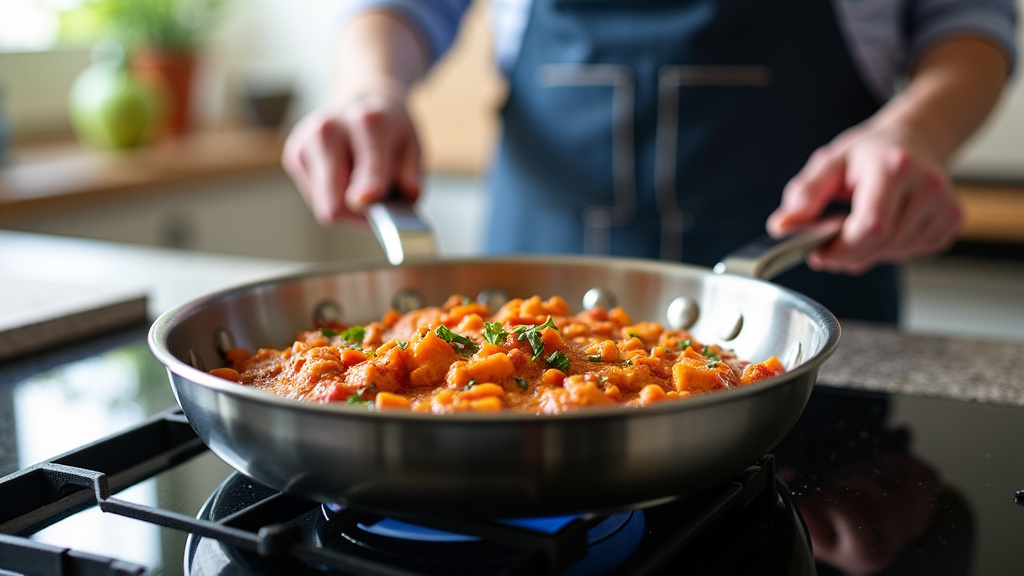
Responsiveness describes how promptly cookware changes temperature when burner output changes. It helps with delicate sauces, eggs, and foods where you may need to reduce heat quickly.
Heat retention describes how well a vessel resists temperature changes. A heavy cast-iron skillet may recover steadily after cold food is added, but it will not cool as quickly when you turn the burner down.
These qualities are not opposites in a simple ranking. A well-designed fully clad cookware may balance quick response with enough mass for stable cooking.
Practical rule: Choose responsive cookware when you make frequent heat adjustments. Choose heavier cookware when steady stored heat is more valuable than quick correction.
How Common Materials Behave
Stainless Steel
Stainless steel makes a durable cooking surface and tolerates many foods, but it does not spread heat as efficiently as aluminum or copper. For that reason, quality stainless cookware usually surrounds or sits above a more conductive layer.
It works well for browning, pan sauces, and general cooking when you learn to preheat and control oil. Food release depends more on technique than it does with a nonstick coating.
Aluminum
Aluminum is relatively light and moves heat efficiently. It appears as bare aluminum, hard-anodized cookware, coated cookware, and the hidden core in stainless pans.
Performance depends heavily on thickness. A substantial aluminum body usually heats more evenly than a very thin one, though it will also weigh and cost more.
Cast Iron and Carbon Steel
Cast iron offers substantial mass and heat retention. Carbon steel is generally thinner and more responsive while still supporting a seasoned surface. Both require drying and maintenance according to the maker’s directions.
They are useful for searing and stovetop-to-oven work when the exact handles and accessories are oven-safe. Acidic cooking and prolonged wet storage can challenge an established seasoned surface.
Copper
Copper responds quickly to burner changes and can distribute heat effectively. Because unlined copper can react with food, cookware commonly uses a stainless or other approved interior lining.
The amount and placement of copper matter. A thin decorative exterior does not guarantee the same behavior as a substantial copper layer within the pan.
Surface Treatments Change the Experience
The base metal does not tell the whole story. A nonstick coating changes release and utensil requirements. Enamel separates food from cast iron and changes maintenance. Anodizing alters the aluminum surface but is not automatically a nonstick coating.
- Nonstick: easy release at moderate heat; coating-specific utensil and temperature limits
- Enameled: no seasoning requirement; protect enamel from impact and thermal shock
- Seasoned: improves with suitable use and care; must be kept clean and dry
- Bare stainless: durable and suitable for fond; requires heat and oil technique
Match the Material to the Cooking Job
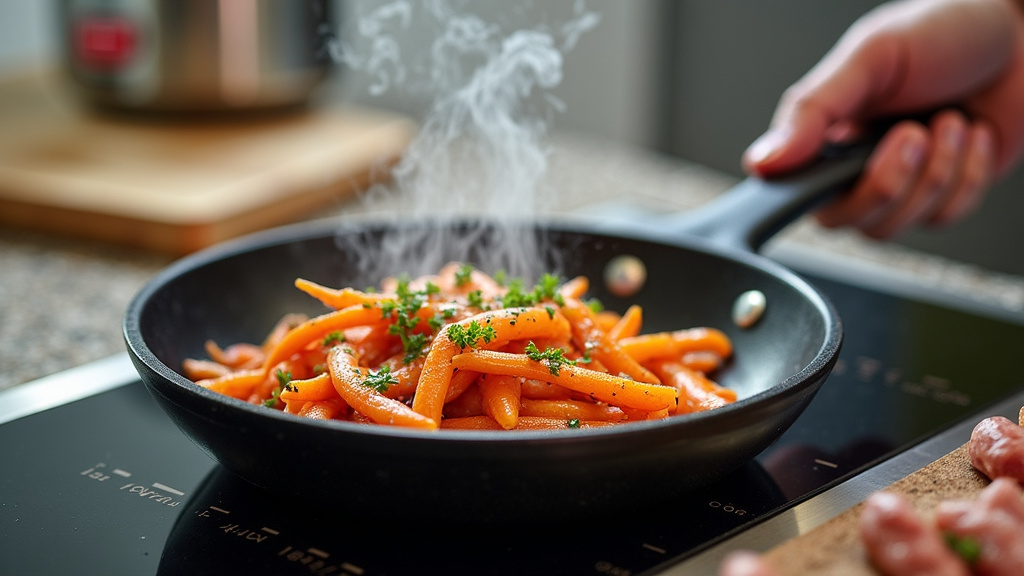
- Identify your most common technique. Searing, simmering, and delicate sauce work reward different behavior.
- Decide how much weight you can handle. Test the pan mentally—or physically—when full.
- Check your cooktop. Induction needs a compatible magnetic base; flatness matters on smooth tops.
- Verify the full heat limit. The lid, knob, coating, and handle may be rated below the body.
- Accept the care routine. Do not buy seasoning-dependent cookware if you will not maintain it.
A balanced kitchen does not need one material
Many cooks use stainless for browning and sauces, one coated pan for delicate foods, and a heavier vessel for heat retention. Buy for repeated tasks rather than forcing one material to do everything.
Common Buying Mistakes
- Assuming all pans made from the same metal perform alike
- Judging a multilayer pan only by the number of plies
- Ignoring total thickness and conductive-layer placement
- Choosing more weight than you can safely lift
- Assuming the pan body, lid, coating, and handle share one heat limit
The Bottom Line
Cookware materials influence heat response, heat retention, weight, durability, food release, and care. Construction determines how strongly those qualities appear.
Compare the whole vessel—material, thickness, layers, pan depth and side shape, and compatibility—then match it to the food and techniques you use most.
Frequently Asked Questions
Which cookware material heats most evenly?
Copper and aluminum conduct heat efficiently, but evenness depends on thickness and construction. Stainless cookware commonly uses one of those metals as a core or base. To compare where that conductive material sits, see clad and disc-bottom construction.
Is heavier cookware always better?
No. More mass can improve heat stability but slows response and makes handling harder. The best weight is one you can control safely for the intended technique.
Does stainless steel work on induction?
Only if the finished pan has a compatible magnetic layer. Confirm the exact model rather than relying on the word “stainless.”
Is hard-anodized cookware automatically nonstick?
No. Anodizing treats the aluminum surface. Many hard-anodized pans add a separate nonstick coating, but the terms are not interchangeable.


