Which Stainless Steel for Knife Blades?
There is no single best stainless steel for knife blades: choose a steel that balances edge retention, toughness, corrosion resistance and ease of sharpening for how you cook. The knife’s heat treatment and blade design matter too.
On this page (8 sections)
- What should you compare in stainless steel for knife blades?
- Does harder steel make a better kitchen knife?
- How do common knife steel types compare?
- Does stainless steel mean a knife cannot rust?
- How do you choose steel for your cooking habits?
- How should you maintain a stainless steel knife edge?
- When should you choose a Japanese or German style?
- Which stainless steel should you choose?
There is no single best stainless steel for knife blades. Choose a kitchen knife by balancing edge retention, toughness, corrosion resistance and how easily you can sharpen it.
A steel that holds an edge for a long time may take more work to sharpen. A tougher, easier-care blade may be a better fit if you use your knives daily and want simple upkeep.
Steel is only part of the decision. Blade shape, edge angle, heat treatment and how you cut also affect how a knife performs.
For a broader overview of types of kitchen knives, start with the job each blade is meant to do.
What should you compare in stainless steel for knife blades?
Compare edge retention, toughness, corrosion resistance and sharpenability before choosing stainless steel for knife blades. These properties involve trade-offs, so decide which ones matter most in your kitchen.
| Property | What it means for you | Consider this if |
|---|---|---|
| Edge retention | How long the edge stays useful between sharpening sessions | You want less frequent sharpening |
| Toughness | How well the blade resists chips or damage under stress | You use a knife for varied kitchen tasks |
| Corrosion resistance | How well the steel resists rust and staining | You want simpler care or often cut moist foods |
| Sharpenability | How much effort it takes to restore the edge | You sharpen your own knives |
| Hardness | Resistance to deformation at the edge | You are comparing steels alongside toughness and sharpening needs |
These are useful comparison points, not a complete prediction of how a knife will feel. Heat treatment and the geometry of the blade influence the result.
Which stainless steel knife blade properties matter most?
The best balance depends on your habits. If you rarely sharpen, edge retention may matter more, but a blade that is difficult to maintain can become frustrating once it dulls.
If you sharpen at home, consider how much time and effort you want to spend. A knife that is easier to sharpen can be a practical choice even if it needs attention more often.
Corrosion resistance matters when you want less worry about moisture, but no kitchen knife should be left wet or dirty for long. Wipe the blade after cutting acidic foods, and wash and dry it after use.
Does harder steel make a better kitchen knife?
Harder steel is not automatically better. It can help an edge resist wear, but the knife still needs a suitable level of toughness and a sharpening routine you can manage.
A hard edge can be a good fit for careful cutting on an appropriate board. It is less suited to tasks that involve twisting, prying or striking hard surfaces.
Use a knife for cutting, and choose a blade style made for the food you prepare.
Steel hardness numbers can help compare knives, but they don’t tell the whole story. Different makers may use different heat treatments, and a well-designed blade can matter as much as a small difference in a published hardness value.
How does heat treatment affect knife steel?
Heat treatment changes how steel behaves by controlling its structure and hardness. The same named steel can perform differently when makers use different heat treatments and blade designs.
That means a steel label is a starting point, not a complete performance promise. Look for clear information about the knife’s intended use and care, and weigh that against the maker’s reputation and warranty.
If a knife does not name its steel grade, you can still assess its shape, construction and care needs. Our guide to best stainless steel kitchen knives compares options for shoppers who want a ready-made shortlist.
How do common knife steel types compare?
Common kitchen knife steels differ in the balance of edge life, toughness, corrosion resistance and upkeep. A steel name alone does not guarantee how a finished knife will perform.
| Steel family or label | General trade-off | A useful question |
|---|---|---|
| Stainless steel | Resists corrosion better than plain carbon steel, though it can still stain or rust | Will you clean and dry the blade after use? |
| High-carbon stainless steel | Adds carbon to a corrosion-resistant steel formula | Does the maker identify the grade and care needs? |
| Powder metallurgy steel | Can support carefully balanced alloy content and edge performance | Is the added edge life worth the cost and sharpening effort? |
| German-style knife steel | Often chosen for everyday versatility and ease of care | Do you prefer a durable all-purpose blade? |
| Japanese-style knife steel | Often chosen for a thinner edge and precise cutting | Are you comfortable with careful use and maintenance? |
These labels cover broad groups, not fixed recipes. Check the exact grade when the maker provides it, and compare the knife’s intended use rather than relying on a country or style name alone.
For more context on steel origin and knife styles, see best Japanese stainless steel knives and best German steel kitchen knives. Those comparisons can help you connect a style preference to a specific knife choice.
Does stainless steel mean a knife cannot rust?
Stainless steel can still stain or rust. It resists corrosion, but moisture, salt and acidic foods can affect an uncleaned or poorly stored blade.
Wash a knife soon after cutting, then dry it before putting it away. Avoid leaving it in a sink or dishwasher unless the maker specifically says it is safe for that care method.
Steel composition affects corrosion resistance, but maintenance still matters. If you are unsure whether a particular knife uses stainless steel, our guide answers are knives made of stainless steel.
How do you choose steel for your cooking habits?
Choose a steel by the balance you want between low-maintenance care, edge life and sharpening effort. Then make sure the knife shape suits the work you do most.
- If you want simple daily care, favor a corrosion-resistant stainless blade and dry it after washing.
- If you want longer intervals between sharpening, compare edge retention while checking how difficult the steel is to sharpen.
- If you cut a wide range of foods, look for a versatile blade with a durable design.
- If you make precise cuts, consider a thinner blade and be ready to use it with care.
- If you sharpen your own knives, consider whether your tools and routine suit the steel.
For a chef knife, compare how the handle, blade length and edge shape fit your grip and cutting style as well as the steel. See our guide to best stainless steel chef knives for examples.
Which stainless steel knife blade is easiest to maintain?
A corrosion-resistant stainless blade that you wash and dry promptly is a practical low-maintenance choice. “Stainless” does not mean you can leave the knife wet, and edge upkeep still depends on use and sharpening.
A blade’s use also matters. A narrow, curved boning knife is made for working close to bone, while a paring knife is meant for smaller prep jobs.
For the comparison, see boning knife vs fillet knife.
The RADA Paring Knife Galore set uses T420 high-carbon stainless steel for its 3 paring knives. Its blades are intended for tasks such as paring apples, trimming chicken breasts and preparing vegetables.
How should you maintain a stainless steel knife edge?
Keep the edge clean, dry and matched to the knife’s intended use. A sharp knife cuts with less force than a dull one, but sharpening methods and edge angles should suit the blade.
Use a cutting board rather than a hard counter, glass or plate. Don’t use the blade to pry, twist or cut frozen food unless the maker says the knife is designed for that work.
A honing rod can help realign an edge between sharpening sessions. Read how to use a knife sharpener rod for a careful technique, and check the knife maker’s guidance before using a tool on a particular edge.
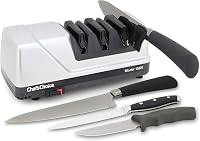
This sharpener is also described for straight-edge and serrated knives. Its angle conversion is a specific feature, not a universal setting for every blade, so check your knife’s edge requirements first.
When should you choose a Japanese or German style?
Choose a knife based on its blade design and care demands, rather than assuming that every Japanese or German knife uses one type of steel. Steel grade, heat treatment and edge geometry vary by maker and model.
A thinner blade can support precise slicing, while a sturdier shape may suit broader daily tasks. These are design tendencies, not rules for every knife in either style.
If you are comparing a layered appearance with practical blade performance, remember that a Damascus pattern describes the blade’s construction or finish, not a guarantee of superior steel. See best Japanese steel kitchen knives and best Damascus kitchen knives for style-specific options.
For a chef knife in that patterned style, compare best Damascus chef knives with the plain stainless options you are considering. Match the blade to your cutting tasks and upkeep habits.
Which stainless steel should you choose?
Choose corrosion resistance and easy care for a low-fuss daily knife, or prioritize edge retention if you are comfortable sharpening less often and can handle a harder edge carefully. For a first kitchen knife, a balanced stainless steel blade with a shape suited to your main tasks is a sensible starting point.
Check the knife’s care instructions and steel grade when available, then compare its blade design and intended use. A good match is the one you can care for and sharpen consistently.
For another brand-specific comparison, see are Cuisinart stainless steel knives good or are stainless steel knives magnetic.
Frequently asked questions
What is the best stainless steel for kitchen knife blades?
There is no best steel for every kitchen knife. Choose based on edge retention, toughness, corrosion resistance and sharpening needs, then consider the blade’s heat treatment and shape.
A steel that suits a low-maintenance home cook may not suit someone who wants a very hard edge and sharpens carefully.
Does stainless steel mean a knife will never rust?
No. Stainless steel resists corrosion, but it can still stain or rust when exposed to moisture, salt or acidic foods and left uncleaned.
Wash and dry kitchen knives after use, and follow the maker’s care instructions.
Stainless describes a level of resistance, not immunity to corrosion.
Is harder steel always better for a knife?
No. Harder steel can support longer edge life, but it may be more difficult to sharpen and can be less forgiving under impact.
Toughness, heat treatment and intended use matter too.
For everyday kitchen work, balance these traits instead of choosing by hardness alone.
What does high-carbon stainless steel mean?
High-carbon stainless steel combines carbon, which can contribute to hardness and edge performance, with alloying elements that help resist corrosion. The exact balance depends on the steel grade and how the blade is made and treated.
The phrase alone does not tell you the knife’s full performance.
How often should you sharpen a stainless steel kitchen knife?
Sharpen when the knife no longer cuts cleanly with normal pressure, rather than following a fixed calendar. How soon that happens depends on the steel, edge angle, cutting surface and use.
Honing can realign an edge between sharpening sessions, but it does not remove the worn metal that sharpening does.