Knife Sharpener vs Whetstone: Which Should You Choose? (November 2026)
Choose an electric knife sharpener for speed and repeatable angles, or a whetstone for control and flexible edge work. Your best choice depends on knife type, sharpening frequency and how much technique you want to learn.
On this page (10 sections)
- Knife sharpener vs whetstone: which is faster?
- Which method gives you more control?
- Which option suits beginners?
- Which method works with more knife types?
- How do grit levels change the result?
- Which one needs less setup and cleanup?
- Which option is easier to maintain?
- How do the products compare for different users?
- What should you choose for Victorinox knives?
- Knife sharpener vs whetstone: what is the final choice?
Choose an electric knife sharpener for speed and repeatable angles, or a whetstone for control and flexible edge care. This knife sharpener vs whetstone comparison looks at how each method fits different knives, habits and skill levels.
An electric sharpener guides the blade through fixed stages in a set sequence. A whetstone asks you to control the angle, pressure and stroke, but it gives you more choice over how much metal you remove and how you finish the edge.
That difference shapes the whole routine. Electric sharpening suits cooks who want a quick, guided pass with little setup.
Stone sharpening suits cooks who want to adjust the work for a dull, damaged or finely finished edge.
Your knife collection matters as much as speed. Learn about different types of kitchen knives before choosing a method, especially if you own serrated knives, thin blades or heavy cleavers.
A serrated blade needs a method designed for that tooth shape. A thin paring knife needs lighter pressure than a heavy cleaver.
A chef knife used daily may benefit from a method you will actually use often.
Frequency also matters. If knives lose their edge quickly because they are used for tough tasks, a fast guided system may keep maintenance simple.
If you enjoy careful hand work, a stone may feel more satisfying.
Storage and counter space are practical factors too. An electric unit needs a power point and a place to sit or be stored safely.
A whetstone needs a stable base, water and room to dry.
Neither method removes the need for suitable boards and safe storage. A sharp edge still needs protection from hard surfaces and loose drawer contact.
The choice is less about which system is best in general. It is about which routine matches your knives, your patience and the way you cook each week.
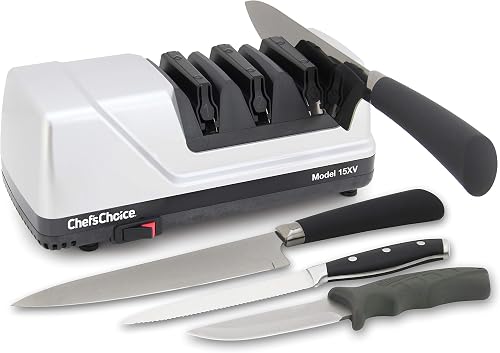 Best for fast edge maintenance
Chef's Choice Chef’sChoice 15XV EdgeSelect Professional Electric Knife
 Best for guided stone sharpening
Sharp Pebble Whetstone Knife Sharpener
Knife sharpener vs whetstone: which is faster?
An electric knife sharpener is usually faster for routine maintenance. The Chef’sChoice 15XV says first-time sharpening takes about 1 minute, while resharpening takes about 10 seconds.
Its 3-stage EdgeSelect system uses diamond abrasives in the first 2 stages, then a flexible abrasive system in stage 3. The stages sharpen, hone and polish, so you can follow a set process rather than choosing a grit by condition.
A whetstone takes more manual time. You need to wet the stone, set it on a stable base, maintain the angle and work both sides of the blade.
That extra time can be useful when the edge needs careful attention. It also gives you a clearer sense of how the blade changes as you move from a coarse grit to a finer one.
Which method gives you more control?
A whetstone gives you more control over angle, pressure and finishing grit. An electric sharpener gives you more consistency when you want a guided path with less manual technique.
The Sharp Pebble 1000/6000 stone gives you a medium sharpening grit and a fine polishing grit. Its included angle guide helps hold the blade position, while the bamboo base supports the stone during use.
The Intelitopia set offers a wider range: 400/1000 and 3000/8000 grits. Its 400 grit suits dull knives, while 3000 and 8000 give you more options for refining and polishing an edge.
This range also adds decisions. You must choose the right side, change stones, keep the surface flat and decide when the edge is ready for the next grit.
The Chef’sChoice 15XV is more limited in the sense that its guided stages determine the sharpening path. Its advantage is that the 15-degree Trizor XV edge is repeatable across compatible knives.
Which option suits beginners?
Choose the Chef’sChoice 15XV for the shortest learning curve, or the Sharp Pebble 1000/6000 for a guided introduction to stones. Both reduce guesswork, but they teach different habits.
The electric sharpener uses precision angle guides and flexible spring guides that adjust automatically. You place the knife into the guide and follow the stage sequence.
A whetstone still requires you to move the blade across the abrasive surface. The angle guide helps, but you need to use steady pressure and avoid rocking the blade.
The Sharp Pebble 400/1000 kit is another simple starting point. Its 400 grit rebuilds a dull or damaged edge, while 1000 grit refines it.
The non-slip rubber base and angle guide support a basic setup.
For more instruction before choosing, read our guide to the best knife sharpener for home use. It can help you match sharpening style to your kitchen routine.
Which method works with more knife types?
The Chef’sChoice 15XV is the clearest choice for a mix of straight-edge and serrated knives. Whetstones are flexible for many blade shapes, but serrated edges need more careful technique.
The 15XV is designed for straight-edge and serrated knives. Its 3 stages include a polishing stage intended to help prolong the life of serrated knives.
Whetstones are useful for chef knives, paring knives, santoku knives and other plain edges. The Intelitopia set also names cleavers, butcher knives, pocket knives, scissors and straight razors among the blades it can sharpen.
That broad use does not mean every blade should be sharpened the same way. Match the grit and angle to the blade, then use light, controlled strokes rather than forcing the edge into the stone.
If you are considering a tumbler-style system, our guide on how to use a tumbler knife sharpener covers the setup and movement involved.
How do grit levels change the result?
Lower grits remove more material and repair dull edges, while higher grits refine and polish the edge. Use a coarse grit only when the knife needs that level of correction.
The Sharp Pebble 400/1000 kit starts with 400 grit for dull or damaged edges and moves to 1000 grit for a smooth, keen finish. It is a focused setup for basic restoration.
The Sharp Pebble 1000/6000 stone starts at a routine sharpening level and finishes with a fine polishing grit. It fits cooks who maintain knives before they become severely dull.
The Intelitopia set covers the widest range in this comparison. The 400/1000 stone handles repair and routine work, while the 3000/8000 stone supports fine finishing.
A higher grit is not automatically better for every knife. If the edge is damaged, polishing alone will not rebuild it.
Start with the grit that matches the condition, then move upward.
Which one needs less setup and cleanup?
The electric sharpener needs the least setup, while water-based whetstones keep cleanup simple but require more preparation. Your available counter space and patience matter here.
The Chef’sChoice 15XV has a simple on/off switch and measures about 10 x 4.25 x 4.25 inches. It weighs 4.2 pounds, so you can store it between uses if you have a suitable cabinet or shelf.
Whetstones need a stable base and water before sharpening. The Sharp Pebble 1000/6000 includes a bamboo base, and the 400/1000 kit includes a non-slip rubber base.
The Intelitopia set includes a bamboo base and 3 non-slip rubber bases, along with multiple stones, a flattening stone, an angle guide and a leather strop. That makes it more complete, but it also creates more pieces to dry and store.
Water-based sharpening avoids honing oil for these stone options. Rinse and dry the stones and bases according to their care needs, and keep the storage area dry between sessions.
Which option is easier to maintain?
An electric sharpener is easier to keep ready for the next session, while whetstones need surface care as they wear. A stone can develop a hollow area if you always sharpen in the same spot.
The Intelitopia set includes a coarse flattening stone for keeping the whetstone flat. The Sharp Pebble 400/1000 kit also includes a flattening stone, which helps maintain a true sharpening surface over time.
The Sharp Pebble 1000/6000 includes a dual-grit stone, bamboo base and angle guide, but it has a simpler tool set. That can make storage easier, though you have fewer options for repair and polishing.
Keep any sharpening method away from loose food and wipe the counter after use. A clean, stable setup helps prevent slips and keeps abrasive residue away from your preparation area.
For another focused comparison, see our guide to the best whetstones for kitchen knives.
How do the products compare for different users?
Pick the Chef’sChoice 15XV for speed, the Sharp Pebble 1000/6000 for guided stone work, the Intelitopia set for the widest grit range, and the Sharp Pebble 400/1000 for basic repair. The right match is more important than choosing the most complex system.
The Chef’sChoice 15XV is the most direct choice when you want an electric process. Its 100-percent diamond abrasives and 3-stage design support sharpening, honing and polishing without manually selecting separate stones.
Its 15-degree Trizor XV edge suits people who want a precise, repeatable angle. The flexible guides reduce the need to hold the blade by hand, but the system gives you less freedom to change the sharpening approach.
The Sharp Pebble 1000/6000 sits between a basic stone and a larger sharpening system. Its 1000 grit handles routine edge work, and its 6000 grit provides a finer finish.
Choose it when you want to learn stone sharpening without starting with several separate stones. It still needs water, careful strokes and a stable setup, but the angle guide can make the first sessions easier.
The Intelitopia set offers the broadest sharpening path here. Its 400/1000 and 3000/8000 stones cover repair through polishing, while the flattening stone helps keep the surface level.
The leather strop adds another finishing step after sharpening. This setup suits someone willing to organize several parts and spend more time learning how each grit changes the edge.
The Sharp Pebble 400/1000 kit keeps the process focused. Use the 400 grit when a knife needs more edge repair, then use the 1000 grit to refine it.
Its non-slip rubber base, flattening stone and angle guide make it a sensible starting point for manual sharpening. It does not include the fine polishing range of the other stone sets.
What should you choose for Victorinox knives?
Choose based on the knife edge and your desired routine, not the brand name alone. A guided electric sharpener can simplify repeatable maintenance, while a whetstone gives you more control over the edge.
Victorinox knives often suit a straightforward maintenance routine, but the correct angle and grit still depend on the specific blade. Our guide to the best Victorinox knife sharpener can help narrow the choice.
Use a suitable cutting surface as well. A good cutting boards guide explains how board material and care affect everyday knife use.
If you mainly prepare roasts or poultry, compare the sharpening needs of your blade with our guide to the chef knife vs butcher knife decision.
Knife sharpener vs whetstone: what is the final choice?
Choose the Chef’sChoice 15XV if speed, guided angles and serrated-knife support matter most. Choose a whetstone if you want more control over repair, refinement and polishing.
The final choice should follow the knives you own and the routine you will keep.
The Sharp Pebble 1000/6000 is the simplest guided stone choice for routine care. Its 1000 grit suits regular sharpening, while its 6000 grit adds a finer finish without needing a separate stone.
The Sharp Pebble 400/1000 is better for basic dull-edge repair. Its coarser 400 grit rebuilds an edge, and its 1000 grit refines it for normal home use.
The Intelitopia set suits readers who want the widest range and do not mind extra setup. Its 400/1000 and 3000/8000 stones cover repair through polishing, with a flattening stone and leather strop for added care.
That wider range comes with more decisions. You need to pick the right grit, keep the stone flat, store each part and learn how each surface changes the blade.
For some cooks that control is the appeal. For others it is extra work they do not need.
The Chef’sChoice 15XV suits a different priority. Its guided stages support straight-edge and serrated knives, and its 15-degree edge offers repeatable sharpening without manually selecting stones.
That repeatability is useful when several household knives need regular maintenance. It is less useful if you want to change angle, pressure or finish for a specific blade.
A sharp edge also needs safe storage and a suitable board. Store blades so edges do not knock against other tools, and choose a cutting surface that supports the edge during daily work.
Those habits affect how long sharpening lasts. Even the best edge can dull faster on a hard board or when a knife is stored loose in a drawer.
If you are preparing large meals, our guide to the best carving knife and fork set can help with the next tool choice. Serving tools do not replace a sharp knife, but they can make slicing and portioning at the table safer and cleaner.
Think about your normal week before you decide. If knives need quick refreshes between meals, choose the guided electric option.
If edges need repair, refinement and polishing at different times, choose a stone setup.
Match the method to the task, and keep the routine simple enough to repeat. A method you use consistently will serve your kitchen better than a more complex system left in a cupboard.
Frequently asked questions
Is a knife sharpener better than a whetstone?
An electric knife sharpener is better for fast, guided sharpening, while a whetstone is better for control and gradual edge work. Choose the electric option if you want repeatable results with less technique.
Choose a whetstone if you want to adjust pressure, angle and grit for different knives.
Which is easier for a beginner, a knife sharpener or whetstone?
A guided electric knife sharpener is usually easier for a beginner because the machine controls the sharpening path and angle. A whetstone takes more practice because you guide the blade by hand.
An included angle guide can make a whetstone less intimidating, but it still needs steady strokes.
Can a whetstone sharpen a serrated knife?
A whetstone can work on some serrated knives, but the teeth require careful attention and a suitable narrow sharpening tool. The Chef’sChoice 15XV is designed for straight-edge and serrated knives, so it is the simpler choice when both knife types are part of your kitchen.
What whetstone grit should you use for kitchen knives?
A 400 grit stone helps rebuild a dull or damaged edge, 1000 grit handles routine sharpening, and higher grits such as 3000, 6000 or 8000 polish the edge. Start with the least coarse grit that matches the knife's condition, then move to a finer grit when needed.
How often should you sharpen kitchen knives?
Sharpen when the knife slips through food, crushes soft produce or needs noticeably more pressure. The right schedule depends on use, storage and cutting-board surface.
Regular honing or light maintenance can reduce how often you need a coarse sharpening stage.