How to Use a Tumbler Knife Sharpener
To use a tumbler knife sharpener, set its angle guide to match your knife, secure the blade, and roll the abrasive across each side with light, even passes. Follow the sharpener's instructions for angle settings and blade position.
On this page (6 sections)
- How do you set the angle on a tumbler knife sharpener?
- How do you secure the knife and roll the abrasive?
- How do you check the edge and finish sharpening?
- What should you avoid when using a tumbler sharpener?
- Which other sharpening tools may suit your knife?
- How should you choose an angle and rolling technique?
To use a tumbler knife sharpener, set the angle guide to match your knife, secure the blade, and roll the abrasive across each side with light, even passes. Follow the sharpener's instructions for angle settings, blade position, and when to switch sides.
A tumbler system pairs a rolling abrasive with a stand or clamp that holds the knife. The guided setup can make the sharpening angle easier to repeat, but the correct setting and rolling path depend on the sharpener and blade.
How do you set the angle on a tumbler knife sharpener?
Choose the angle recommended for your knife and supported by the sharpener. The goal is to meet the blade's existing bevel evenly, rather than guess at a new angle.
Some sharpeners use a magnetic angle guide or marked settings. Set the guide before clamping the knife, and check the tool's instructions if the markings are unfamiliar.
Keep the blade straight in the holder, with the edge exposed enough for the abrasive to reach it. If the knife has a curved profile, position it as the sharpener's instructions show so the rolling surface can follow the edge.
A sharpener's angle may not suit every knife. For background on blade shapes and uses, see our guide to types of kitchen knives.
For a direct comparison of two blade styles, see nakiri vs chef knife.
How do you secure the knife and roll the abrasive?
Clamp the knife firmly, then roll the abrasive from heel toward tip in smooth, controlled passes. Keep the roller in contact with the edge and use light pressure throughout.
- Place the knife in the holder with the edge facing the roller.
- Align the blade according to the sharpener's angle guide.
- Tighten the clamp so the knife can't shift.
- Roll the abrasive along the full edge, from heel toward tip.
- Turn the knife or move the setup as directed to sharpen the other side.
- Check the edge before doing more passes.
Keep your fingers clear of the edge and roller path. Work on a flat, stable surface, and don't let the blade move inside the clamp as you roll.
Use the same steady motion on the heel, belly, and tip. At the curved tip, guide the roller along the blade's shape without tipping it off the edge.
How many passes should each side get?
Use the pass count in the sharpener's instructions, and start with light, even rolls. The number needed can vary with the blade's condition and the abrasive.
Avoid grinding one spot repeatedly or bearing down to speed up the job. Check progress between short sets of passes, and stop when the edge is consistent rather than continuing by habit.
How do you check the edge and finish sharpening?
Check for a consistent edge using a safe method recommended by the sharpener's maker. Don't run a finger along the blade to test sharpness.
Wipe away any metal residue with a cloth, keeping the edge pointed away from your hand. If the tool calls for a finishing step or a different abrasive, follow that sequence.
Wash and dry the knife before returning it to storage. Clean the sharpener as directed, since trapped metal particles or debris can affect later use.
If the knife remains dull, first check that it was clamped at the correct angle and that the roller reached the whole edge. Repeating heavy passes without correcting alignment can remove more material without fixing the problem.
What should you avoid when using a tumbler sharpener?
Don't guess at the angle, let the knife shift, or use force to compensate for poor contact. Those mistakes can create an uneven edge or damage the blade.
Check whether your knife's shape and steel are suitable for the sharpener. Follow its guidance for straight, curved, coated, or serrated blades, and don't assume one method fits every edge.
A tumbler isn't the only way to maintain a kitchen knife. If you're weighing guided rollers against other methods, compare the options in our guide to the best knife sharpener for home use.
Which other sharpening tools may suit your knife?
Choose a sharpening method that matches your comfort with angle control and the knife's edge. A tumbler offers a guided rolling motion; an electric sharpener or whetstone follows a different process.
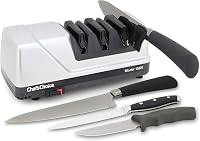
The Chef'sChoice 15XV uses precision angle guides and a 3-stage system for straight-edge and serrated knives.
The Sharp Pebble whetstone has 1000 and 6000 grit sides, plus an angle guide for water-based sharpening.
The Intelitopia set includes 400/1000 and 3000/8000 grit stones, a flattening stone, and an angle guide.
For brand-specific options, compare our guides to the best Victorinox knife sharpener, best Wusthof knife sharpener, and best DMT knife sharpener. If you're sharpening a serrated table knife, read how to sharpen steak knives first.
How should you choose an angle and rolling technique?
For a tumbler knife sharpener, match the guide to the knife, clamp it securely, and roll smoothly along the full edge. Start with the sharpener's instructions, then use short sets of light passes and check the result before continuing.
Choose the angle your knife calls for and the sharpener supports. If you want to compare blade styles before choosing a sharpening method, see our chef knife vs santoku guide and Milk Street nakiri knife review.
Frequently asked questions
What angle should I use on a tumbler knife sharpener?
Use the angle recommended for your knife and supported by your tumbler sharpener. If you don't know the edge angle, check the knife or sharpener instructions before sharpening; setting an angle that differs from the existing edge can change how the knife cuts.
How many times should I roll a tumbler knife sharpener?
There isn't one pass count for every blade or sharpener. Start with a few light, controlled rolls on one side, then follow the tool's instructions for alternating sides and checking progress; stop when the edge feels consistent and avoid pressing hard.
Can you use a tumbler sharpener on a serrated knife?
Check the tumbler sharpener's instructions before using it on a serrated blade. Many rolling systems are designed for straight edges, while serrations need a method that reaches each bevel without flattening the teeth.
Is a tumbler knife sharpener suitable for beginners?
A tumbler sharpener can make angle control easier because its guide holds the knife at a set position while you roll the abrasive. Beginners still need a stable surface, a secured blade, light pressure, and the maker's instructions for their specific tool.