9 Best Non-Toxic Frying Pans (November 2026)
The best non-toxic frying pans include the SENSARTE Nonstick Ceramic Frying Pan Skillet for everyday eggs, the SENSARTE Ceramic Nonstick Frying Pan Skillet for deep pan cooking, and the CAROTE 10" Tri-Ply Stainless Steel Frying Pan for uncoated searing.
On this page (10 sections)
- How we compared non-toxic frying pans
- Compare the frying pan surfaces and disclosures
- The best non-toxic frying pans by use
- Which frying pan material is best for health?
- What should you check in a non-toxic pan disclosure?
- How do care and heat affect coated frying pans?
- Are ceramic pans a good choice if you want easy food release?
- Is an uncoated stainless steel pan right for you?
- How should you choose a frying pan size?
- Which non-toxic frying pan should you choose?
The best frying pans for health-conscious cooking depend on the surface you want: choose uncoated stainless steel to avoid a nonstick coating, or a ceramic pan when easy food release matters. Compare the maker’s specific chemical disclosures and care directions rather than relying on broad terms such as “healthy” or “non-toxic.”
For a broader look across pots and pans, start with our best non-toxic cookware picks. This roundup compares frying pans by disclosed cooking surface, construction, and useful care details.
Our picks at a glance
-
1
 Best for everyday eggs
SENSARTE Nonstick Ceramic Frying Pan Skillet
9.7/10 our score
See it on Amazon -
2
 Best for deep pan cooking
SENSARTE Ceramic Nonstick Frying Pan Skillet
9.6/10 our score
See it on Amazon -
3
 Best for uncoated searing
CAROTE 10" Tri-Ply Stainless Steel Frying Pan
9.5/10 our score
See it on Amazon
- 4
 Check it
Astercook 19 Pcs Pots and Pans Set
Best for a coated set - 5
 Check it
KREHOUD Okura Titanium Pans for Cooking
Best for an uncoated titanium surface - 6
 Check it
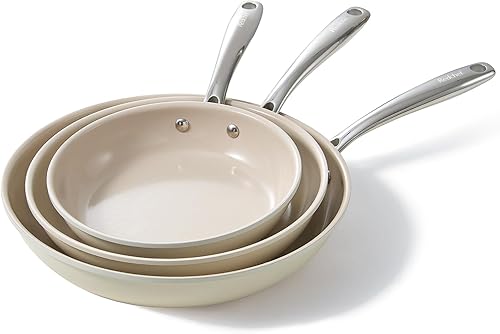
Redchef Non Stick Ceramic Frying Pans
Best for three ceramic sizes - 7
 Check it
Redchef Stainless Steel Frying Pan Set
Best for coating-free pan variety - 8
 Best for a granite-style coatingCheck it
- 9
 Check it
ESLITE LIFE Nonstick Ceramic Frying Pans Skillets
Best for low to medium heat
How we compared non-toxic frying pans
The best frying pans for health-conscious buyers disclose the cooking surface and give practical care guidance. We compared those details, along with pan size, cooktop compatibility, and whether each surface is coated.
A “non-toxic” label alone does not tell you the exact materials or establish how a pan performs over time. Manufacturer statements about chemical exclusions are useful to compare, but they are not independent testing.
We favor clear disclosures and describe them as claims where appropriate.
Our score weighs specs, features and buyer feedback against what you’re shopping for. A higher score here reflects how closely a pan’s materials and disclosures match this roundup’s focus, not a medical judgment or a lab safety result.
Compare the frying pan surfaces and disclosures
The main difference is whether you want a coating at all: stainless steel is uncoated, while ceramic and titanium nonstick pans have coated surfaces. For a closer comparison, read stainless steel cookware vs nonstick.
Read each material description carefully because “titanium” can refer to a coating or to a cooking surface.
| Product | Best for | Surface | Pan material | Care | Our score |
|---|---|---|---|---|---|
| SENSARTE Nonstick Ceramic Frying Pan Skillet | everyday eggs | Ceramic nonstick | Aluminum and ceramic | Hand washing recommended | 9.7 |
| SENSARTE Ceramic Nonstick Frying Pan Skillet | deep pan cooking | Ceramic nonstick | Aluminum | Hand wash only | 9.6 |
| CAROTE 10" Tri-Ply Stainless Steel Frying Pan | uncoated searing | Stainless steel | Stainless steel with aluminum core | Dishwasher safe | 9.5 |
| Astercook 19 Pcs Pots and Pans Set | a coated set | Titanium nonstick coating | Aluminum and titanium | Care instructions not specified | 9.4 |
| KREHOUD Okura Titanium Pans for Cooking | an uncoated titanium surface | Pure titanium, as described by KREHOUD | Dishwasher safe; dry fully after washing | 9.3 | |
| Redchef Non Stick Ceramic Frying Pans | three ceramic sizes | Ceramic nonstick | Aluminum, ceramic, and stainless steel | Dishwasher safe; hand washing recommended | 9.1 |
| Redchef Stainless Steel Frying Pan Set | coating-free pan variety | Uncoated stainless steel | 8.8 | ||
| Yonida Non Stick Frying Pans | a granite-style coating | Nonstick granite coating | Aluminum | Dishwasher safe | 8.6 |
| ESLITE LIFE Nonstick Ceramic Frying Pans Skillets | low to medium heat | Ceramic nonstick | Aluminum | Dishwasher safe; low to medium heat recommended | 8.2 |
The best non-toxic frying pans by use
The right pick depends on the cooking surface and care routine you prefer. These pans range from a small ceramic skillet to multi-size stainless steel sets.
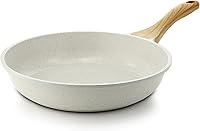
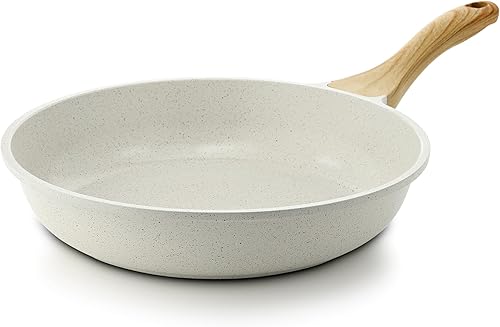
SENSARTE Nonstick Ceramic Frying Pan Skillet: Best for everyday eggs
- Ceramic coating
- Stated free of PFAS, PFOA, lead, and cadmium
- 9.5 in
- Induction compatible
A 9.5 in ceramic skillet for eggs and omelets, with a smooth nonstick surface and induction compatibility. SENSARTE says the pan is free of PFAS, PFOA, lead, and cadmium.
Pros
- Ceramic coating disclosure
- Induction compatible
- No rivets on the cooking surface
Cons
- Hand washing is recommended to extend surface life
- Nonstick surface needs gentle care
The SENSARTE Nonstick Ceramic Frying Pan Skillet is a 9.5 in choice for eggs, omelets, and other meals where food release matters. Its cooking surface is ceramic, and the body is aluminum with an induction base.
SENSARTE describes the pan as free of PFAS, PFOA, lead, and cadmium. The brand also says its surface produces no toxic substances if overheated, but that statement is not a substitute for following the included heat guidance.
The no-rivet design makes the cooking surface easier to wipe clean, and SENSARTE recommends hand washing to extend the nonstick surface life. Use a soft sponge and avoid steel wool or metal utensils to reduce wear.
Choose it if a single ceramic pan for everyday eggs is your priority. If you'd rather avoid coated surfaces altogether, compare it with an uncoated option below.
SENSARTE Ceramic Nonstick Frying Pan Skillet: Best for deep pan cooking
- Ceramic nonstick surface
- 5 qt capacity
- Induction compatible
- Includes lid
This 5 qt ceramic skillet has a lid and a helper handle for larger meals and pan cooking. SENSARTE says its surface is free of PFAS, PFOA, PTFE, PFOS, lead, and cadmium.
Pros
- Large capacity
- Lid included
- Induction compatible
Cons
- Hand wash only
- Larger than a basic egg pan
This SENSARTE skillet suits cooks who need more room than a standard egg pan offers. It has a 5 qt capacity, a lid, and a helper handle, with a ceramic nonstick surface over an aluminum body.
SENSARTE says this pan is free of PFAS, PFOA, PTFE, PFOS, lead, and cadmium. It is compatible with gas, electric coil, and smooth induction cooktops, so the listed compatibility covers common home ranges.
The maker recommends hand washing to extend the nonstick surface life. The larger shape can handle sautéing, stir-frying, simmering, and other one-pan meals, but it will take more cabinet space than a compact skillet.
Pick it if you want ceramic nonstick in a deep pan with a lid. For a guide to the material category, read what to know about non-toxic ceramic cookware.
CAROTE 10" Tri-Ply Stainless Steel Frying Pan: Best for uncoated searing
- Stainless steel cooking surface
- Tri-ply construction
- Oven and broiler safe to 600 F
- Dishwasher safe
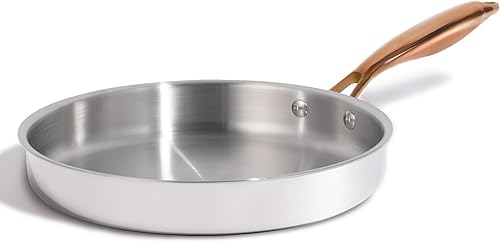
A 10 in stainless steel pan with a responsive aluminum core between stainless steel layers. Its uncoated cooking surface suits searing and pan sauces.
Pros
- No nonstick coating
- Works on induction
- Oven and broiler safe to 600 F
Cons
- Food can stick without suitable heat and cooking technique
- Stainless steel surface needs more active cleanup
The CAROTE 10" Tri-Ply Stainless Steel Frying Pan is the clearest option here for a cook who wants an uncoated cooking surface. For a broader stainless set comparison, see best All-Clad cookware.
Its stainless steel layers sandwich a responsive aluminum core, and the 10 in size suits quick meals and single servings.
Stainless steel does not release food like a nonstick coating, so technique matters. Preheating and adding oil at the right time can help with sticking, while browned bits can be deglazed for a pan sauce.
CAROTE says the pan works on all cooktops, including induction, and is oven and broiler safe to 600 F. For help choosing cookware for a gas range, see cookware for gas stoves.
It is also dishwasher safe.
If you’re comparing more stainless options, see our stainless steel cookware safety guide.
Astercook 19 Pcs Pots and Pans Set: Best for a coated set
- Titanium nonstick coating
- Set includes 8 in and 9.5 in frying pans
- Stated free of PFAS, PTFE, PFOA, and PFOS
- Induction compatible
The 19-piece set includes two frying pans and other cookware. Astercook describes a titanium nonstick coating and says the set is free of PFAS, PTFE, PFOA, and PFOS.
Pros
- Two frying pan sizes
- Induction compatible
- Set includes pan protectors
Cons
- A full set takes more storage space
- The cooking surface is coated
Astercook’s 19-piece set suits buyers replacing several pans and pots at once. It includes 8 in and 9.5 in frying pans, plus a 5 qt sauté pan, a 5 qt stockpot, a saucepan, pan protectors, a silicone mat, and utensils.
The frying pans have a titanium nonstick coating, according to Astercook’s material description. The brand states the set is free of PFAS, PTFE, PFOA, and PFOS, and says it works on induction, gas, and ceramic stovetops.
This is a coated surface, so it fits a different preference from uncoated stainless steel. Consider how you will store the full set and whether you want a nonstick coating across multiple pieces.
KREHOUD Okura Titanium Pans for Cooking: Best for an uncoated titanium surface
- 12 in pan with lid
- Pure titanium cooking surface, as described by KREHOUD
- Stated free of PFAS, PFOA, and PTFE
- Dishwasher safe
KREHOUD describes this 12 in pan as having a pure titanium cooking surface without chemical coatings. It is a distinct option for cooks who want to avoid coated nonstick surfaces.
Pros
- No chemical coating, as described by KREHOUD
- Induction compatible
- Lid included
Cons
- The pan weighs 5.6 lb
- The cooking method includes preheating and oiling
KREHOUD’s 12 in Okura pan is aimed at cooks curious about titanium without a chemical nonstick coating. KREHOUD describes a pure titanium cooking surface with a tri-ply structure that includes an aluminum core, steel core, and titanium alloy reinforcement.
The brand says the pan is free of PFAS, PFOA, and PTFE. Its care guidance calls for preheating on medium-low, adding oil, and letting ingredients set before moving them.
That technique differs from a slick ceramic pan, where food release is the main draw.
The pan includes a lid, works on induction, and is dishwasher safe. KREHOUD recommends drying it fully after washing to help prevent discoloration or oxidation.
Choose it if you want a titanium cooking surface and are comfortable using oil and controlled preheating. For more titanium options, compare our best titanium frying pans.
Redchef Non Stick Ceramic Frying Pans: Best for three ceramic sizes
- Set includes 8 in, 9.5 in, and 11 in pans
- Ceramic coating
- Induction compatible
- Hand washing recommended to extend coating life
This set groups three ceramic-coated pan sizes for different portions. Redchef describes the surface as free of PFAS, PFOA, PTFE, lead, and cadmium.
Pros
- Three sizes in one set
- Induction compatible
- Stainless steel handles
Cons
- More storage space needed
- Hand washing is recommended to extend coating life
Redchef’s set includes 8 in, 9.5 in, and 11 in ceramic frying pans, so it covers smaller and larger portions. The pans combine aluminum, ceramic, and stainless steel, with stainless steel handles.
Redchef describes the coating as free of PFAS, PFOA, PTFE, lead, and cadmium. The set works on induction, gas, and electric stovetops, and the brand recommends hand washing to extend coating life even though dishwasher use is listed.
The stated oven limit is 842 F for the handle and coating. Check your recipe and oven setup before using that limit, and avoid assuming all ceramic coatings share the same heat tolerance.
Pick this set if you want several ceramic pan sizes in one purchase. If you are also comparing bakeware coatings, our mini muffin pan material guide uses the same approach of checking material and coating disclosures.
Redchef Stainless Steel Frying Pan Set: Best for coating-free pan variety
- Uncoated stainless steel surfaces
- Set includes 8 in, 9.5 in, and 11 in pans
- Tri-ply construction
- Stated free of PFAS, PTFE, PFOA, and PFOS
The three-pan set uses uncoated stainless steel surfaces and tri-ply construction. It suits cooks who want several sizes without a nonstick layer.
Pros
- Three sizes
- Uncoated cooking surfaces
- Suitable for searing and browning
Cons
- Pan dimensions and care instructions need confirmation
- Food release differs from nonstick cookware
Redchef’s stainless steel set provides 8 in, 9.5 in, and 11 in pans with uncoated cooking surfaces. Its tri-ply construction combines a stainless steel surface, aluminum core, and magnetic stainless steel base.
Redchef says these pans are free of PFAS, PTFE, PFOA, and PFOS. The brand describes the set as suited to searing, browning, and building fond for pan sauces, where stainless steel’s cooking surface is useful.
Choose this set if you want several pan sizes without a nonstick coating. The supplied care details do not specify dishwasher or oven use, so check the instructions that come with the pans before choosing a cleaning or oven routine.
Yonida Non Stick Frying Pans: Best for a granite-style coating
- 10 in pan
- Nonstick granite coating
- Aluminum body
- PFOA-free claim
This 10 in aluminum skillet has a nonstick granite-style surface. Yonida describes it as PFOA free, but the available material disclosures do not address every PFAS-related term.
Pros
- 10 in everyday size
- Induction compatible
- Dishwasher safe
Cons
- Disclosure names PFOA, not a broader list of coating chemicals
- Coated surface needs care
Yonida’s 10 in skillet uses an aluminum body and a nonstick granite-style coating. Yonida describes the pan as PFOA free, compatible with induction, and dishwasher and oven safe.
That disclosure is narrower than the statements attached to some other picks here. If you want information about additional coating chemicals, confirm the full material description before buying rather than treating “granite” as a precise coating composition.
Choose it if a single nonstick pan and broad cooktop compatibility matter most. Buyers who want a clearer list of exclusions may prefer one of the ceramic or stainless steel options above.
ESLITE LIFE Nonstick Ceramic Frying Pans Skillets: Best for low to medium heat
- Ceramic nonstick surface
- Stated free of PTFE and PFOA
- Induction compatible
- Use on low to medium heat
This aluminum skillet has a ceramic nonstick surface and works on induction. ESLITE LIFE says it is free of PTFE and PFOA, and recommends low to medium heat.
Pros
- Ceramic surface
- Induction compatible
- Low to medium heat guidance
Cons
- Maximum stated temperature is 480 F
- Disclosure names PTFE and PFOA, not every coating chemical
ESLITE LIFE’s skillet has an aluminum body and ceramic nonstick surface. The brand says it is free of PTFE and PFOA, works on gas, electric, ceramic, and induction cooktops, and recommends low to medium heat.
The pan is described as oven safe up to 480 F. Dishwasher use is also listed, though gentler hand washing can help limit wear on a coated cooking surface.
Its chemical disclosure names PTFE and PFOA, rather than a longer list of substances. Choose it if you want ceramic nonstick and plan to follow the low to medium heat guidance.
Which frying pan material is best for health?
The best frying pan material for health-conscious shopping is the one whose surface and care instructions fit your priorities. Uncoated stainless steel avoids nonstick coating ingredients, while ceramic-coated pans trade that bare surface for easier food release.
Titanium needs closer reading because the word can describe a coating or the cooking surface itself. Astercook describes a titanium nonstick coating, while KREHOUD describes its pan as having a pure titanium cooking surface without chemical coatings.
No material label alone proves a pan is safer for every person or use. Compare the maker’s stated exclusions, keep the pan in good condition, and follow the heat and cleaning guidance.
What should you check in a non-toxic pan disclosure?
Check the exact cooking surface, the pan body materials, and the specific chemicals the brand says are excluded. A ceramic surface, granite-style coating, and uncoated stainless steel are different constructions, even when each is marketed for health-conscious cooking.
Look for named terms such as PFAS, PTFE, PFOA, or lead, and note when the disclosure names only some of them. Broad phrases such as “healthy” or “non-toxic” do not explain the full surface composition.
Also compare care instructions. A pan that recommends hand washing or lower heat may need a different routine than a dishwasher-safe stainless steel pan.
How do care and heat affect coated frying pans?
Care guidance matters because coatings need a routine that helps limit wear. Several ceramic picks recommend hand washing, gentle sponges, and avoiding steel wool or metal utensils.
Use the temperature guidance for the exact pan. ESLITE LIFE recommends low to medium heat, while the SENSARTE and Redchef pans provide different maximum temperature details.
Stop using a coated pan if its surface is damaged or peeling. Follow the brand’s care guidance and replace cookware when its surface condition changes.
Are ceramic pans a good choice if you want easy food release?
Ceramic-coated pans can suit cooks who value easy food release and simpler cleanup. The SENSARTE and Redchef pans here have ceramic surfaces and manufacturer statements naming several chemical exclusions.
Those claims do not mean every ceramic pan has the same composition or care needs. Compare the exact chemical language, heat limits, and cleaning directions for each model.
Is an uncoated stainless steel pan right for you?
An uncoated stainless steel pan is a practical choice if avoiding a nonstick coating is your main goal. The CAROTE and Redchef stainless steel options use stainless cooking surfaces, with aluminum cores described in their construction details.
Stainless steel may require more attention to preheating and oil than a nonstick surface. It can suit searing and browning, but it is less forgiving for delicate foods that you expect to slide free without technique.
How should you choose a frying pan size?
Choose a diameter that fits both your usual portions and your storage space. The picks range from 9.5 in and 10 in pans to 12 in options, while the Redchef sets offer three separate sizes.
A larger pan gives food more room but can be harder to store and maneuver. Before ordering, compare the cooking area and rim diameter using our guide to measuring a frying pan’s diameter.
Which non-toxic frying pan should you choose?
Pick the SENSARTE 9.5 in ceramic skillet for everyday eggs and a disclosed ceramic surface, or choose CAROTE for uncoated stainless steel and searing. KREHOUD is the titanium option with a described uncoated cooking surface, while Redchef offers multiple ceramic or stainless sizes.
For broader cookware shopping, return to our best non-toxic cookware guide. Match the pan to the surface you prefer, then follow its care and heat instructions.
Our top 3 picks at a glance
-
1
Best for everyday eggs
SENSARTE Nonstick Ceramic Frying Pan Skillet
9.7/10 our score
See it on Amazon -
2
Best for deep pan cooking
SENSARTE Ceramic Nonstick Frying Pan Skillet
9.6/10 our score
See it on Amazon -
3
Best for uncoated searing
CAROTE 10" Tri-Ply Stainless Steel Frying Pan
9.5/10 our score
See it on Amazon
Frequently asked questions
Which frying pan is best for health?
There is no single pan that is best for every health-conscious cook. An uncoated stainless steel pan avoids a nonstick coating, while ceramic and other coated pans offer easier food release.
Compare the exact material and chemical disclosures, then follow the care and heat guidance for the pan you choose.
For stainless steel options, see our stainless steel cookware guide.
Are ceramic frying pans non-toxic?
Ceramic-coated pans are not the same as bare ceramic, so check what the maker says the coating contains and which substances it excludes. In this roundup, SENSARTE and Redchef describe specific pans as free of several named substances, but those are manufacturer statements rather than independent proof.
Our guide to ceramic cookware and non-toxic claims explains what to compare.
Is titanium cookware a good choice for health-conscious cooking?
Titanium cookware varies in construction. KREHOUD describes its pan as having a pure titanium cooking surface without a chemical coating, while Astercook describes a titanium nonstick coating.
Check whether you want a bare surface or a coated one, and review the full material description.
How do I choose the right frying pan size?
Match the cooking surface to your usual portions and cooktop. A 9.5 or 10 in pan suits smaller everyday jobs, while a 12 in skillet gives more room for larger meals.
Measure across the top rim to compare pan diameter; our frying pan diameter guide shows where to measure.
Can a frying pan be dishwasher safe and non-toxic?
Dishwasher compatibility and coating composition are separate questions. Some pans here are described as dishwasher safe, while others recommend hand washing to extend the surface life.
Check both the material disclosure and care instructions, and see our dishwasher-safe non-toxic cookware guide for more options.