When Does a Griddle Serve a Different Purpose from a Skillet?
On this page (11 sections)
- Griddle vs. Skillet at a Glance
- When a Griddle Is the Better Tool
- When a Skillet Is the Better Tool
- How Size and Burner Layout Affect the Choice
- Better Technique on a Griddle
- Common Buying and Cooking Mistakes
- Care and Compatibility
- Three Everyday Decisions
- The Bottom Line
- Frequently Asked Questions
- Sources and Further Reading
Quick answer: Choose a griddle when you want a broad, open surface for several thin foods. Choose a skillet when you need higher sides to contain oil, juices, loose ingredients, or sauce.
A griddle makes pancakes, eggs, tortillas, bacon, and sandwiches easier to arrange and flip. A skillet is the more flexible choice for sautéing, shallow frying, and meals that need stirring.
The two pans may use similar materials, but their geometry changes how you work. A griddle prioritizes access and batch space; a skillet trades some openness for containment and versatility.
Griddle vs. Skillet at a Glance
| Feature | Griddle | Skillet |
|---|---|---|
| Edges | Very low rim | Higher, usually flared sides |
| Best strength | Easy flipping and batch layout | Containing food, oil, and liquid |
| Typical foods | Pancakes, eggs, flatbreads, sandwiches | Vegetables, cutlets, sauces, mixed meals |
| Main limitation | Weak spill and splatter control | Less side access and batch width |
When a Griddle Is the Better Tool
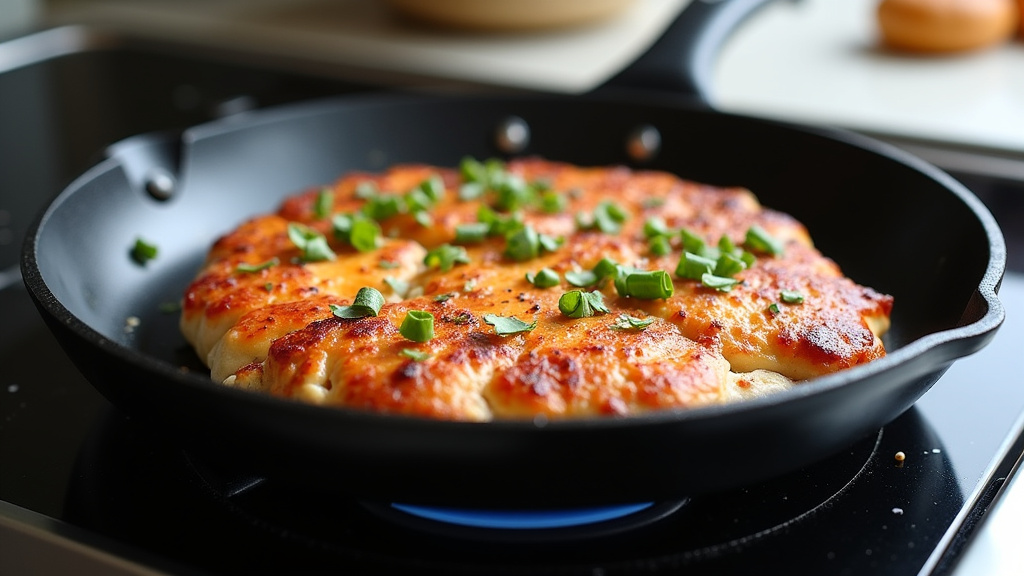
A griddle is especially useful when food lies flat and needs frequent turning. The low rim lets a wide turner approach from different angles without colliding with a wall.
- Breakfast batches: several pancakes, eggs, or slices of French toast can cook without stacking.
- Grilled sandwiches: open access makes pressing and turning easier.
- Tortillas and flatbreads: the broad surface provides room to warm several pieces.
- Burgers or bacon: a griddle can provide useful batch space when grease has a safe channel or collection area.
The advantage is not simply total width. It is usable width that remains accessible to your tools. A skillet with the same rim diameter loses some flat floor area to its sloped sides, which can also affect pan capacity.
Best fit: A griddle earns its storage space when you regularly cook multiple flat portions at once. For one egg or one sandwich, a skillet may be just as convenient.
When a Skillet Is the Better Tool
A skillet is safer and easier when food releases liquid, needs vigorous stirring, or may splatter. For another comparison of pans used for active cooking, see the chef’s pan and wok guide. Its walls keep chopped ingredients from escaping while still allowing good evaporation.
Reach for a skillet for vegetable sautés, pan sauces, cutlets, shallow frying, and one-pan meals; for sauce-focused cookware, compare the saucepan and saucier. It also gives you more flexibility when a recipe changes direction—for example, when browned ingredients need a small amount of broth or sauce.
A griddle should not be treated as a rimless all-purpose pan. Thin batter, generous oil, or a loose stir-fry can move toward the edge quickly, especially if the cooktop is not level.
How Size and Burner Layout Affect the Choice
A large griddle may span two burners. That adds cooking space, but the surface may develop separate hot and cool zones. Burner output, contact area, and the griddle’s material all affect how evenly it heats.
- Measure the usable flat area. Ignore handles and decorative outer dimensions.
- Check burner coverage. Oversized cookware can heat slowly or unevenly beyond the flame or element.
- Confirm that it sits level. Oil and grease should not run toward an unprotected edge.
- Plan storage. A rectangular griddle may not stack neatly with round pans.
Better Technique on a Griddle
Preheat gradually, then test more than one area with a small amount of food. On a two-burner model, adjust each burner separately rather than assuming both zones are identical.
Leave open space around each portion. Crowding makes flipping harder and traps steam, which works against crisp browning. Move food between hotter and cooler zones when that helps timing.
Grease warning: For bacon, burgers, or other fatty foods, use a model with an appropriate rim or grease channel. Do not let hot grease collect near an exposed edge, burner, or control.
Common Buying and Cooking Mistakes
- Choosing by overall width instead of usable cooking area
- Using a nearly rimless surface for a liquid-heavy dish
- Filling every inch and leaving no room for a turner
- Assuming a two-burner griddle heats evenly from end to end
- Ignoring the material, coating, utensil, and temperature instructions
Care and Compatibility
Follow the instructions for the exact material and surface. Protect nonstick coatings from prohibited tools, and dry bare cast iron or carbon steel promptly before maintaining it as directed.
Do not place a hot griddle under cold water unless the manufacturer permits it. The large, relatively flat shape can be vulnerable to thermal shock and warping. Also confirm induction, oven, and broiler compatibility rather than assuming the body and handles share the same limit.
Three Everyday Decisions
Weekend pancakes for a family
The griddle is usually the easier choice because several pancakes can cook in parallel. Keep enough open space for the turner and use heat zones to manage pieces that finish at different times.
Chicken cutlets followed by a pan sauce
The skillet is more useful. Its walls contain oil during browning and hold the finishing liquid. Work in batches if crowding would trap steam.
One grilled cheese sandwich
Either pan works. The skillet may be faster to retrieve, clean, and store, which matters more than maximum surface area for a single portion.
These examples show why frequency and batch size matter as much as pan shape. Specialty cookware is valuable when its advantage repeats often enough to justify the space.
The Bottom Line
Use a griddle for open access, easy flipping, and batches of flat food. Use a skillet for containment, stirring, sauces, and broader everyday versatility. If you rarely cook several flat portions at once, the skillet is usually the more useful single purchase.
Frequently Asked Questions
Can a skillet replace a griddle?
For small batches, usually yes. A skillet gives up some open surface and tool access but handles a wider range of foods.
Can you cook bacon on a griddle?
Yes, if the griddle safely contains or channels the rendered grease. Follow the model’s instructions and never let grease approach an exposed edge.
Why does a two-burner griddle have hot spots?
Each burner creates its own heat zone, and the space between them may be cooler. Construction, contact, and burner output also influence the pattern.
Is a flat-top appliance the same as a stovetop griddle?
They use a similar open-surface idea, but heat sources, grease management, controls, and installation differ.
Which is easier to store?
A round skillet usually stacks more easily. A long rectangular griddle may need vertical or dedicated storage.


