Dutch Oven Sizes: Which Size Should You Choose?
Choose a Dutch oven size based on your usual batch, with a little room for stirring: about 5 to 6 qt suits many everyday meals, while 7 to 8 qt gives more space for large batches and whole poultry. Check the pot's shape and your storage space before deciding.
On this page (11 sections)
- What Dutch oven size works for everyday cooking?
- Which Dutch oven size fits your recipes?
- Should you choose a round or oval Dutch oven?
- How do you balance capacity with storage space?
- What if you need a pot for a different job?
- How should you choose between 5, 6 and 8 qt?
- Which Dutch oven size should you choose?
- Does an 8 qt stockpot work as a Dutch oven alternative?
- Is a bigger Dutch oven always better?
- What should you check before choosing?
- How we researched Dutch oven sizes
The best Dutch oven size for you depends on how much you cook at once and what you make. About 5 to 6 qt suits many everyday meals, while 7 to 8 qt gives more room for large batches, bigger ingredients and leftovers.
Capacity is only a starting point. A wide, shallow pot and a narrow, deep one can hold the same volume but behave differently when you brown meat, stir a stew or fit a loaf.
If you're comparing pot capacities, first learn how to measure the capacity of a pot in quarts. Then match the size to your recipes, serving habits and kitchen storage.
What Dutch oven size works for everyday cooking?
For everyday cooking, 5 to 6 qt is a practical starting range for many households. Choose a smaller pot for side dishes and modest batches, or move up when your routine includes meal prep, larger cuts or frequent guests.
These ranges are guidelines, not strict serving limits. The shape and depth of a particular pot affect how well ingredients fit and how easily you can stir them.
| Capacity | A useful starting point | Consider a different size if |
|---|---|---|
| 2 to 3 qt | Sauces, sides and small portions | You cook full meals or want leftovers |
| 4 to 5 qt | Smaller everyday batches | You often cook for guests or use large cuts |
| 5 to 6 qt | Many soups, stews and braises | Your recipes need room for a whole bird or large batch |
| 7 to 8 qt | Large batches, leftovers and bigger ingredients | Cabinet space or lifting weight is a concern |
| 9 qt and up | Very large cooks and bulky ingredients | You rarely need that much volume or lack storage |
Use the table to narrow your options, then check the recipe and the pot's inside dimensions. A 6 qt pot with a broad base may give you more room to brown ingredients in one layer than a taller pot of the same capacity.
How do Dutch oven sizes compare by servings?
A 4 to 5 qt pot can suit a few portions, while 6 to 8 qt offers a more flexible range for a family meal and leftovers. Serving estimates vary because a broth-heavy soup, a dense stew and a braise with bones take up space differently.
Think about how much you cook, not just how many people are at the table. If you routinely cook once and eat several times, leave room for the larger batch.
For recipes that specify a pot size, follow that guidance when you can. The recipe may rely on enough surface area for browning or enough headroom for a long simmer.
Which Dutch oven size fits your recipes?
Choose a pot that fits your largest regular recipe, rather than buying around a one-time meal. A little extra capacity helps with bubbling and stirring, but a much larger pot can be awkward for small batches.
| Recipe or task | Size to consider | What to check |
|---|---|---|
| Sauces and small sides | 2 to 3 qt | Whether the base suits your burner |
| Small stew or braise | 4 to 5 qt | Whether the ingredients fit without crowding |
| Everyday soup or stew | 5 to 6 qt | Headroom for simmering and stirring |
| Large batch or meal prep | 7 to 8 qt | Filled weight and available storage |
| Whole chicken or larger roast | 6 to 8 qt | Interior width, height and recipe instructions |
| Bread baking | Recipe-specific | Dough size, pot diameter and lid clearance |
A pot that's too small can crowd ingredients and leave little space for bubbling. A very large pot can make a modest batch spread thinly across the bottom, so check whether the recipe needs a particular depth or cooking surface.
For bread, compare the recipe's recommended pot diameter and the loaf's proofed size. Capacity alone does not tell you whether the dough or parchment will fit comfortably.
How much headroom should you leave?
Leave space above the food for stirring and bubbling, rather than filling a Dutch oven right to its rim. A soup or stew can move as it simmers, and a full pot is harder to carry without spilling.
The usable space depends on the recipe and how vigorously it cooks. If your usual recipe fills a pot almost to the top, size up or reduce the batch.
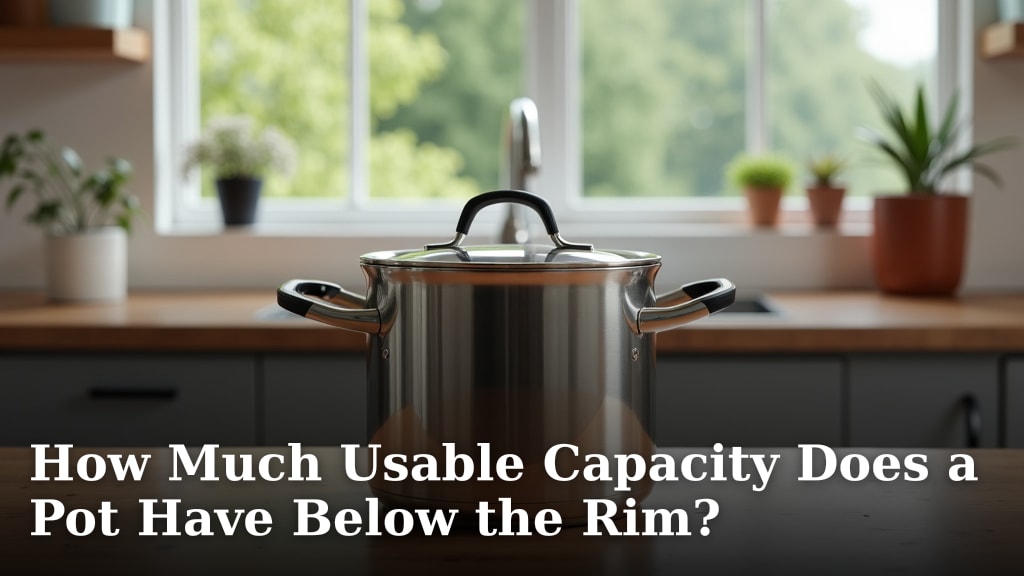
A pot's capacity number usually describes volume up to the rim. See how much usable capacity a pot has below the rim to understand why the working volume is lower.
Should you choose a round or oval Dutch oven?
Choose a round Dutch oven for general stovetop use and an oval one when your recipes often involve long cuts or whole poultry. Check the burner and oven fit, since the same capacity can have a different footprint.
A round base is easier to center over a typical burner. An oval shape can make it simpler to place a long roast or bird, though part of its base may extend beyond a round burner.
For stovetop browning, match the pot's base to the burner so heat reaches the cooking surface evenly. For oven recipes, check that the pot and its lid fit with room for safe handling.
How do you balance capacity with storage space?
Measure the pot's outside width, height and handle span against your cabinet, shelf or drawer. A capacity that suits your recipes may still be inconvenient if the pot and lid don't fit where you plan to store them.
Remember to account for the lid and any handles that extend past the body. If you store cookware in a lower cabinet, consider the weight of the empty pot and whether you can lift it comfortably.
For a bigger Dutch oven, compare the dimensions with your oven rack and stovetop. A pot can fit inside the oven yet crowd other cookware or make the lid difficult to lift.
If you're comparing the largest options from a specific brand, see what the largest Le Creuset Dutch oven is. Its size may suit a large batch, but make sure you have a clear place to store it.
What if you need a pot for a different job?
Choose a Dutch oven for recipes that benefit from its combination of stovetop and oven cooking. For tall, narrow batches of stock or pasta, a stockpot may use space differently; our guide explains the difference between a stockpot and a Dutch oven.
An 8 qt stockpot is a separate option when you mainly need volume for soup, stock or boiling. Compare the best 8 quart stock pots if that shape fits your cooking better.
For smaller cooking jobs, choose cookware sized to the task. A 2 qt saucepan is sized for sauces and small batches:
A roasting pan works for oven roasts that need a broad, shallow space instead of a deep pot:
How should you choose between 5, 6 and 8 qt?
Choose 5 qt for smaller everyday batches, 6 qt for a flexible middle ground, and 8 qt for frequent large cooks. If you're unsure, start with the recipes you make most often and check their volume before sizing up.
A 5 qt pot can be easier to store and handle, but may leave little room for a large roast or a full batch of soup. A 6 qt option suits a wider mix of meals without taking as much room as a larger pot.
An 8 qt pot provides more working room for bigger ingredients and leftovers. It can be a better fit for batch cooking, but weigh the extra size against your cabinet, oven and lifting needs.
If you're still torn, compare the size of the ingredients that take the most room. A whole bird or large roast may call for a wider pot even if its total capacity seems similar to your usual stew pot.
Which Dutch oven size should you choose?
Pick the smallest Dutch oven that comfortably fits your largest regular recipe with room to stir. Choose 5 to 6 qt for many everyday meals, and consider 7 to 8 qt when large batches, whole poultry or leftovers are part of your routine.
Before you buy, check the interior shape, outside dimensions, lid clearance and storage location. If you mainly need tall capacity for stock or boiling, compare the best 8 quart stock pots instead of choosing a Dutch oven by quarts alone.
Does an 8 qt stockpot work as a Dutch oven alternative?
An 8 qt stockpot can hold large volumes of liquid, but its tall shape may not suit recipes that need broad stovetop browning or oven braising. Check whether the stockpot is oven-safe and whether its handles and lid suit the recipe before using it as a substitute.
The capacity number helps compare volume, but it doesn't make two pot styles interchangeable. Use a Dutch oven when the recipe calls for its shape and oven use, and choose a stockpot when height and liquid capacity matter more.
Is a bigger Dutch oven always better?
A bigger Dutch oven is useful when you regularly cook large batches, but it can take more storage space and be heavier to lift. A smaller pot may suit everyday recipes better and leave room for stirring if you don't routinely cook for a crowd.
Size up for a real pattern, such as weekly batch cooking or frequent large roasts. Don't choose extra capacity based only on the idea that you might use it someday.
What should you check before choosing?
Check the recipe's suggested pot size, the pot's inside shape and the available space in your kitchen. Capacity, burner fit and storage all matter when choosing between Dutch oven sizes.
Use this short checklist:
- Note your most common batch and your largest regular recipe.
- Leave headroom for bubbling and stirring.
- Compare the pot's base with your burner.
- Measure your oven, cabinet and shelf space.
- Consider whether a round or oval shape suits your recipes.
- Choose a stockpot or roasting pan when that shape fits the job better.
The right size is the one that works with the food you cook and the space you have. Match the quarts to your routine, then confirm the physical dimensions before deciding.
How we researched Dutch oven sizes
We compared common capacity ranges with the kinds of recipes people cook in Dutch ovens, including soups, stews, braises and bread. The size guidance is a starting point; follow your recipe's instructions and check the dimensions of the pot you are considering.
Frequently asked questions
What size Dutch oven is best for a family of four?
A 5 to 6 qt Dutch oven is a useful starting point for many family meals, while 7 to 8 qt gives extra room for larger batches, leftovers or a whole chicken. The right size depends on how much you cook at once, the recipe and whether you want space to stir without filling the pot to the rim.
Is a 5 qt Dutch oven big enough?
A 5 qt Dutch oven can handle many everyday soups, stews, braises and smaller batches. It may feel tight for a large roast, a whole bird or a recipe that needs room for bubbling and stirring, so compare the pot's shape and the recipe's ingredients before choosing.
Should I buy a 7 qt or 8 qt Dutch oven?
Choose 7 qt if you want more capacity than an everyday pot but still need a manageable footprint; choose 8 qt when your recipes regularly make large batches or need room for bigger ingredients. Measure cabinet and oven space too, since the larger pot can be harder to store and lift.
Does a Dutch oven's stated capacity mean I can fill it to the top?
No. Capacity is the volume to the rim, and bubbling food needs headroom for stirring and safe handling.
Leave space based on the recipe and contents, especially with soups and stews, and compare usable capacity below the rim before assuming a pot will hold a full batch.
Can one Dutch oven size work for bread and stew?
Often, but the best size depends on the loaf or batch. A medium pot can work for everyday stews and many round loaves; a larger one gives extra room for bigger recipes but takes more storage space.
Check the recipe's recommended pot dimensions and lid clearance before baking.