What Is a Honing Rod for a Knife?
A honing rod helps realign a knife's edge between sharpening sessions. It maintains a usable edge but usually does not remove enough metal to repair a truly dull or damaged blade.
On this page (9 sections)
- What Is a Honing Rod for a Knife?
- How does a honing rod maintain a knife edge?
- What is the difference between honing and sharpening?
- How should you use a honing rod safely?
- Which knives benefit most from a honing rod?
- Can a honing rod replace a knife sharpener?
- Are ceramic bowls useful while maintaining kitchen knives?
- How do you know when honing is no longer enough?
- What is a honing rod for a knife, in simple terms?
What Is a Honing Rod for a Knife?
A honing rod helps realign a knife's edge between sharpening sessions. It maintains a usable edge but usually does not remove enough metal to repair a truly dull, chipped, or damaged blade.
During cutting, the thin edge can bend slightly from side to side. The knife may still look sharp, yet it can feel less controlled on food.
A honing rod can bring that edge closer to alignment with a few light, controlled passes.
A rod is part of normal knife care, not a replacement for every sharpening method. If you're still choosing a blade, start with our guide to types of kitchen knives, since different edges need different care.
How does a honing rod maintain a knife edge?
A honing rod maintains an edge by gently guiding a slightly misaligned edge back toward its center line. The rod does this through contact with the blade, while the knife moves at a consistent angle.
Hold the rod securely with its tip resting on a stable cutting board, or use another safe position that gives you control. Keep the knife at a modest angle and move the blade from heel to tip without pressing hard.
The exact angle depends on the knife and the edge you want to maintain. A rod won't correct a large chip, a rounded edge, or a blade that no longer cuts after careful honing.
Use slow movements until the motion feels consistent. Speed adds little value if the edge angle changes from pass to pass.
What is the difference between honing and sharpening?
Honing maintains the existing edge, while sharpening removes metal to create a new edge. Honing suits a knife that has lost some bite but still cuts, while sharpening suits a blade that remains dull after honing.
A steel honing rod mainly supports edge alignment. Ceramic and diamond rods can also remove a small amount of metal because their surfaces are abrasive.
That makes rod material important when you compare a ceramic vs steel honing rod.
A whetstone removes material through an abrasive surface and requires more control over angle and pressure. A powered sharpener uses guided stages and can be easier for someone who wants a repeatable process.
The Sharp Pebble Whetstone Knife Sharpener includes a dual-grit stone, bamboo base, angle guide, instruction manual, tips and tricks ebook, and sharpening expert support. Its 1000 grit is intended for dull or damaged edges, while 6000 grit is for polishing.
Choose a whetstone when honing no longer brings back a useful edge and you want a manual sharpening method. Compare honing rods and whetstones before choosing.
It takes more setup than a rod because the stone uses water and the blade must travel across the abrasive surface at a controlled angle.
For the full choice between tools, see Honing Rod vs Knife Sharpener: Which Do You Need?.
How should you use a honing rod safely?
Use a honing rod with light pressure, a steady angle, and a clear path for the blade. Keep your fingers away from the edge and work slowly enough to control the knife from heel to tip.
A simple method is:
- Place the rod in a stable position.
- Set the heel of the knife near the top of the rod.
- Keep the blade at a consistent angle.
- Draw the knife down and toward you until the tip reaches the lower part of the rod.
- Repeat on the other side with light pressure.
- Stop after a small number of controlled passes and check the knife on suitable food.
Don't scrape the knife rapidly against the rod or force the edge into the surface. Heavy pressure can fold the edge further or remove more material than you intended.
Clean and dry the rod according to its material and design. Keep it separate from loose utensils so the surface does not collect residue or suffer unnecessary impact.
Which knives benefit most from a honing rod?
A honing rod is most useful for common straight-edge kitchen knives that receive regular cutting use. Chef knives, utility knives, and similar blades can benefit when their edges begin to feel less smooth but are not fully dull.
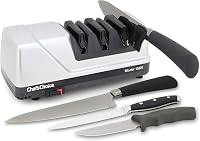
The Chef'sChoice 15XV uses 100-percent diamond abrasives, precision angle guides, and a 3-stage system. It converts traditional 20-degree household knife edges to 15-degree Trizor XV edges, with stages for sharpening, honing, and polishing.
This tool suits someone who wants guided electric sharpening for both straight-edge and serrated knives. It measures about 10 x 4.25 x 4.25 in and has a simple on/off switch.
It is a sharpening machine, so it belongs later in the care cycle than a honing rod. Use a rod for light maintenance, then consider a powered sharpener when the edge stays dull or needs a new profile.
Our guide to the best honing rods for kitchen knives can help you compare rod styles before choosing one.
Serrated knives need special care because their cutting edges have recessed sections. A flat rod is not automatically suitable for every serrated pattern, so follow the tool's intended use.
For more knife-specific choices, compare a chef knife vs utility knife and learn how a boning knife vs fillet knife differs in shape and cutting work.
Can a honing rod replace a knife sharpener?
A honing rod cannot replace a knife sharpener when the blade is genuinely dull or damaged. It can delay sharpening by maintaining an edge, but it cannot restore substantial missing metal or repair a deep chip.
Use the rod when:
- The knife still cuts but feels less smooth.
- The edge appears slightly rolled rather than visibly damaged.
- You want a quick maintenance step between sharpening sessions.
- You can keep the blade angle and pressure under control.
Use a sharpener or whetstone when:
- The knife slips across food instead of starting a cut.
- Honing makes little difference.
- The edge has chips or a rounded profile.
- You need to change the edge angle.
A diamond honing rod can sit between these roles because its abrasive surface may remove a small amount of metal. That does not make it a complete replacement for every sharpening method.
See our guide to the best diamond honing rod if you need a more abrasive rod option.
Are ceramic bowls useful while maintaining kitchen knives?
A stable work area matters when you inspect, hone, or sharpen a knife. Keep food and loose dishes away from the blade path, and use a bowl only for holding ingredients after the knife work is complete.
The DOWAN 22 OZ White Ceramic Bowls Set includes 4 round ceramic bowls measuring 6 in wide by 2.75 in high. They are microwave safe, dishwasher safe, freezer safe, and oven safe, with a soft white finish.
These bowls don't sharpen or hone knives. They help when you want separate containers for prepared ingredients, sauces, fruit, rice, or other foods while keeping the cutting area clear.
Keep the bowls away from the knife edge and don't use their rims as a cutting surface. Ceramic can damage a blade if the edge strikes it, so place ingredients in the bowl only after cutting or transfer them with a suitable utensil.
How do you know when honing is no longer enough?
Honing is no longer enough when the knife remains dull after a few careful passes and a clean test cut. A knife that needs force, slips on food, or tears instead of slicing may need sharpening.
Test the knife on an appropriate food rather than your finger. If the blade still struggles, stop honing and choose a sharpening method suited to its edge.
Look at the edge under good light. A visible chip, bent section, or rounded profile points to sharpening or professional service rather than more passes on a rod.
The right care cycle is simple: hone for routine maintenance, sharpen when the edge is dull, and replace or service a damaged knife when sharpening cannot correct the problem.
What is a honing rod for a knife, in simple terms?
A honing rod is for maintaining a knife edge that has shifted slightly during use. It can make a serviceable knife feel more controlled, but it won't restore a badly dull or damaged blade.
Pick a steel rod for basic alignment, a ceramic or diamond rod when you need some abrasive action, and a whetstone or guided electric sharpener when the edge needs real sharpening. Learning the different chef knife names can also help you match care tools to the blade you use most.
Frequently asked questions
What is a honing rod for a knife?
A honing rod is for maintaining a knife edge between sharpening sessions. It helps realign an edge that has rolled slightly during normal cutting, which can improve the knife's feel and control.
It is not a substitute for sharpening when the blade is very dull, chipped, or damaged.
Does a honing rod sharpen a knife?
A honing rod can maintain an edge, but a standard steel rod usually does not sharpen a very dull knife in the same way as a whetstone or powered sharpener. Some ceramic and diamond rods remove a small amount of metal, so check the rod type and use light pressure.
How often should you use a honing rod?
Use a honing rod when a knife starts to feel less smooth during ordinary cutting, rather than following a fixed daily schedule. A few light passes may help maintain the edge, but repeated heavy pressure can damage the edge.
Sharpen the knife when honing no longer restores useful cutting.
Can you use a honing rod on every knife?
No. Match the rod to the blade and its edge.
A standard rod may suit many common kitchen knives, while delicate, very hard, serrated, or unusually thin blades need more care.
Use a method designed for serrated knives instead of dragging a flat rod across the scallops.