How to Use a Chef'sChoice Knife Sharpener
To use a Chef'sChoice knife sharpener, identify your model, read its instructions, and draw the knife through the correct stage with light, steady pressure. Models and stage sequences differ, so follow the manual for your exact sharpener.
On this page (7 sections)
- How do you use a Chef'sChoice knife sharpener?
- How do Chef'sChoice models differ?
- How many passes should you make?
- Can you sharpen a serrated knife with a Chef'sChoice?
- What should you do before and after sharpening?
- What if you prefer sharpening by hand?
- Which Chef'sChoice knife sharpener should you choose?
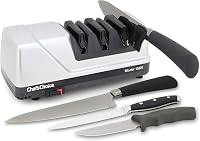
To use a Chef'sChoice knife sharpener, identify your model, read its instructions, and draw the knife through the correct stage with light, steady pressure. The 15XV has 3 stages, but other Chef'sChoice models may use different steps.
Start with a clean, dry knife and a stable work surface. Keep your fingers away from the blade edge, and don't sharpen a knife in a stage unless the model's manual says that stage is suitable for it.
How do you use a Chef'sChoice knife sharpener?
Follow the instructions for your exact model and use its stages in the order it specifies. For the 15XV, draw the knife through the slots so the blade stays against the guides, then repeat the pass as directed in its manual.
- Set the sharpener on a stable, dry counter.
- Check the manual for approved blade types and stage instructions.
- Hold the knife by its handle and place its heel in the slot.
- Draw the blade through the slot, from heel to tip, at the pace the manual recommends.
- Repeat as directed, keeping the blade against the guides.
- Check the edge carefully and stop when you've followed the manual's sharpening steps.
Don't push the blade down or saw it back and forth unless the manual tells you to. Use light, controlled movement, and keep the cord and appliance away from water.
What are the 15XV's stages for?
The 15XV uses stages 1 and 2 to sharpen and hone straight-edge knives, then stage 3 to polish. Its first 2 stages use diamond abrasives, while the third uses a flexible abrasive system.
Chef'sChoice describes the 15XV as able to convert a traditional 20-degree household knife edge to a 15-degree Trizor XV edge. Because that changes the edge geometry, check that this is appropriate for your knife before sharpening.
For serrated knives, the 15XV's stage 3 is designed to polish and help prolong the life of the serrations. Follow the instructions for your specific blade rather than putting it through the straight-edge sharpening steps.
How do you hold the knife in the slot?
Keep the blade aligned with the guides and draw it through smoothly. The 15XV has flexible spring guides that adjust the angle and help control the blade's position.
Start each pass with the knife heel in the slot, then pull through until the tip clears. Avoid twisting the blade or lifting it during the pass.
Don't assume every electric model uses the same slot layout or motion. Check your manual for the correct side, stage, and number of passes.
How do Chef'sChoice models differ?
Chef'sChoice sharpeners vary by model, stage layout, and the blades they support. Check the model number and manual before following instructions written for another sharpener.
The 15XV is a 3-stage electric model with diamond abrasives in its first 2 stages and a flexible abrasive system in its final stage. It's designed for straight-edge and serrated knives.
Other sharpeners may use different stages or sharpening methods. Our guide to best knife sharpener for home use compares common options, while types of kitchen knives can help you identify the blade you have.
Choose the 15XV if you want an electric sharpener that can convert a traditional 20-degree edge to a 15-degree edge. Check that your knife suits that edge angle and follow the model manual for each pass.
How many passes should you make?
Use the number of passes specified in your model's manual, then check the edge before continuing. The right amount depends on the model, the knife's condition, and the stage.
The 15XV describes sharpening as taking about 1 minute the first time and resharpening about 10 seconds. Those are maker-provided time estimates, not a substitute for following the instructions or checking the result.
Avoid extra passes once the edge is sharp enough for your needs. More sharpening than needed can remove material from the blade.
Can you sharpen a serrated knife with a Chef'sChoice?
Only use a stage that your model approves for serrated blades. On the 15XV, stage 3 is designed to polish and help prolong the life of serrated knives.
Don't run a serrated knife through stages 1 or 2 unless your model's manual specifically directs you to do so. The 15XV's stages 1 and 2 are described for sharpening and honing straight-edge knives.
A serrated blade's edge pattern differs from a straight-edge blade. If you have a Japanese knife or another blade with care instructions, see our guide to types of Japanese kitchen knives and follow its maker's guidance.
What should you do before and after sharpening?
Read the manual, secure the sharpener, and keep the work area dry. Unplug an electric sharpener before cleaning it, and follow its care instructions.
Check the knife for damage before sharpening. If the blade is cracked, bent, or chipped, seek qualified repair advice rather than trying to fix it with a household sharpener.
Wipe the blade carefully after sharpening and store it so the edge doesn't contact other utensils. For routine edge care between sharpening sessions, compare ceramic vs steel honing rod.
What if you prefer sharpening by hand?
A whetstone gives you a manual option, but it requires its own technique and setup. Follow the stone's instructions for wetting, angle, and safe handling.
The Sharp Pebble stone has 1000 and 6000 grit surfaces, an angle guide, and a bamboo base. Its 1000 grit side is intended for dull or damaged edges, and its 6000 grit side for polishing.
The Intelitopia set includes 400/1000 and 3000/8000 grit stones, a flattening stone, a leather strop, a bamboo base, and an angle guide. Its coarser stone can sharpen dull knives, while its finer combination is for polishing.
A whetstone doesn't work like an electric slot sharpener. Learn the method before starting, and consider how to use a Tumbler knife sharpener if you're comparing another guided sharpening style.
Which Chef'sChoice knife sharpener should you choose?
Choose based on your knife type, preferred sharpening method, and the instructions you can follow consistently. For names and roles of chef knife styles, see chef knife types.
The 15XV suits readers looking for a 3-stage electric sharpener with guides and support for straight-edge and serrated knives.
If you're comparing models, see best Chef'sChoice knife sharpeners. For a different brand and sharpening style, our guide to best Victorinox knife sharpeners covers another option.
A sharpener works only when its stages match the blade and you use them as directed. Check the model number first, then follow that model's steps each time you sharpen.
Frequently asked questions
How do you use a Chef'sChoice electric knife sharpener?
Check the model manual, place the sharpener on a stable surface, and use the stage and technique specified for your knife. For the 15XV, pull the blade through the slot while keeping it in contact with the guide, then repeat as directed.
Unplug the unit before cleaning.
Which Chef'sChoice stage should I use?
The right stage depends on your Chef'sChoice model, blade, and whether you're sharpening, honing, or polishing. The 15XV has 3 stages: its first 2 use diamond abrasives to sharpen and hone straight-edge knives, while stage 3 polishes and helps prolong serrated knife life.
Follow its manual.
Can you sharpen a serrated knife with a Chef'sChoice sharpener?
Some Chef'sChoice models are designed for serrated knives, but their approved stages and steps vary. The 15XV's third stage uses a flexible abrasive system to polish and help prolong serrated knife life.
Check your model's manual before using any stage on a serrated blade.
How often should you sharpen a kitchen knife?
Sharpen when the knife no longer cuts as cleanly as you need, rather than following a fixed calendar. The interval depends on the knife, how often you use it, and how you maintain it.
Honing can help realign an edge between sharpening sessions, but it doesn't replace sharpening.